

The Du’ā of Tawakkul
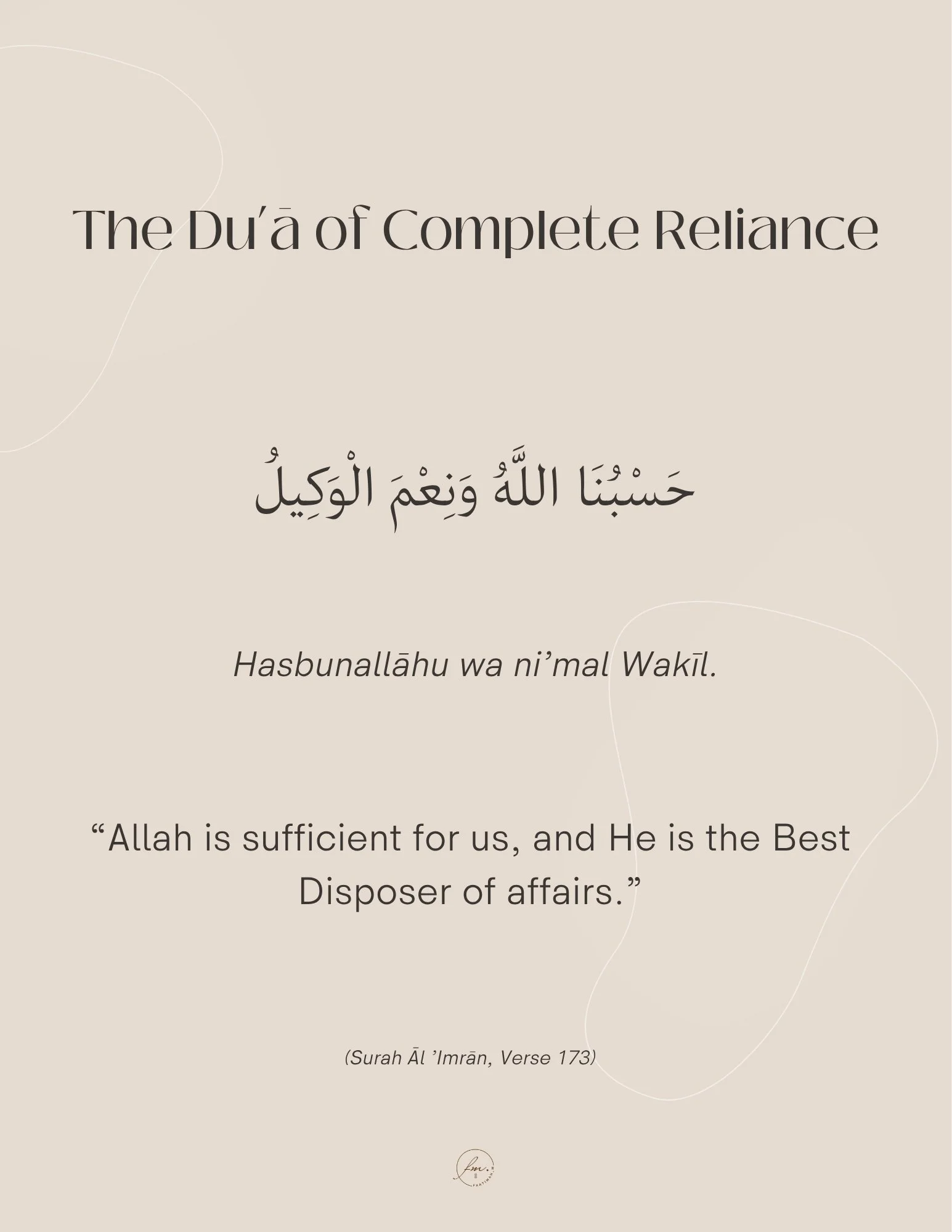
This is such a small du’ā, but it carries such a huge meaning.
And perhaps that is what makes it so powerful.
“Allah is sufficient for us.”
Not, “Everything will go exactly the way I want.”
Not, “Nothing bad will ever happen.”
Not, “I know how this is going to end.”
Simply:
Allah is sufficient for me.
That is tawakkul.
Tawakkul is not knowing what will happen and feeling completely unafraid.
It is not sitting back and doing nothing.
It is not expecting Allah to give us exactly what we ask for.
Tawakkul is doing what you can, while knowing that the outcome was never yours to control.
And this du’ā comes from a beautiful moment in the Qur’ān.
The believers were warned that people had gathered against them and that they should be afraid.
That news could have caused them to panic.
Instead, it increased their faith, and they said:
“Allah is Sufficient for us, and He is the Best Disposer of affairs.”
I think this is where tawakkul becomes real.
It is easy to say we trust Allah when everything is going according to plan.
But what happens when you receive the message you were dreading?
When the person does not respond?
When the relationship ends?
When the opportunity falls through?
When your plans suddenly change?
When you do not know how you will manage financially?
When you are waiting for an answer and your mind keeps creating ten different scenarios?
This is where we have to practise tawakkul.
Not by pretending that we are not worried.
But by reminding ourselves:
I do not know what will happen. Allah does.
I cannot control the outcome. Allah can.
I may not understand this. Allah does.
And there is another important part of tawakkul that we sometimes forget.
The believers did not hear the frightening news and simply sit at home saying, “Allah is sufficient.”
They responded.
They continued forward.
They did what was required of them.
Then they entrusted the outcome to Allah.
This is tawakkul.
Tie your camel, then trust Allah.
Make the effort.
Have the conversation.
Apply for the job.
Seek advice.
Set the boundary.
Take the necessary steps.
Make the du’ā.
Then release what was never in your hands to begin with.
Perhaps today, choose one thing you have been trying desperately to control.
Maybe it is someone’s decision.
Maybe it is your future.
Maybe it is your rizq.
Maybe it is something you have been overthinking for days.
Take a moment and say:
Ḥasbunallāhu wa niʿmal wakīl.
Say it slowly.
Say it when your mind starts racing.
Say it when fear begins taking over.
Say it after you have done everything within your ability.
And let it remind you:
I have Allah.
I do not need to know every detail of what comes next.
I do not need to control every outcome.
I just need to keep turning to the One who does.
May Allah strengthen our tawakkul, teach us to take the means without becoming dependent upon the means, and give our hearts the certainty to say, even when we cannot see the way forward,
“Allah is Sufficient for me, and He is the Best Disposer of affairs.”