

Sayyidul Istighfār: More Than Just Asking for Forgiveness
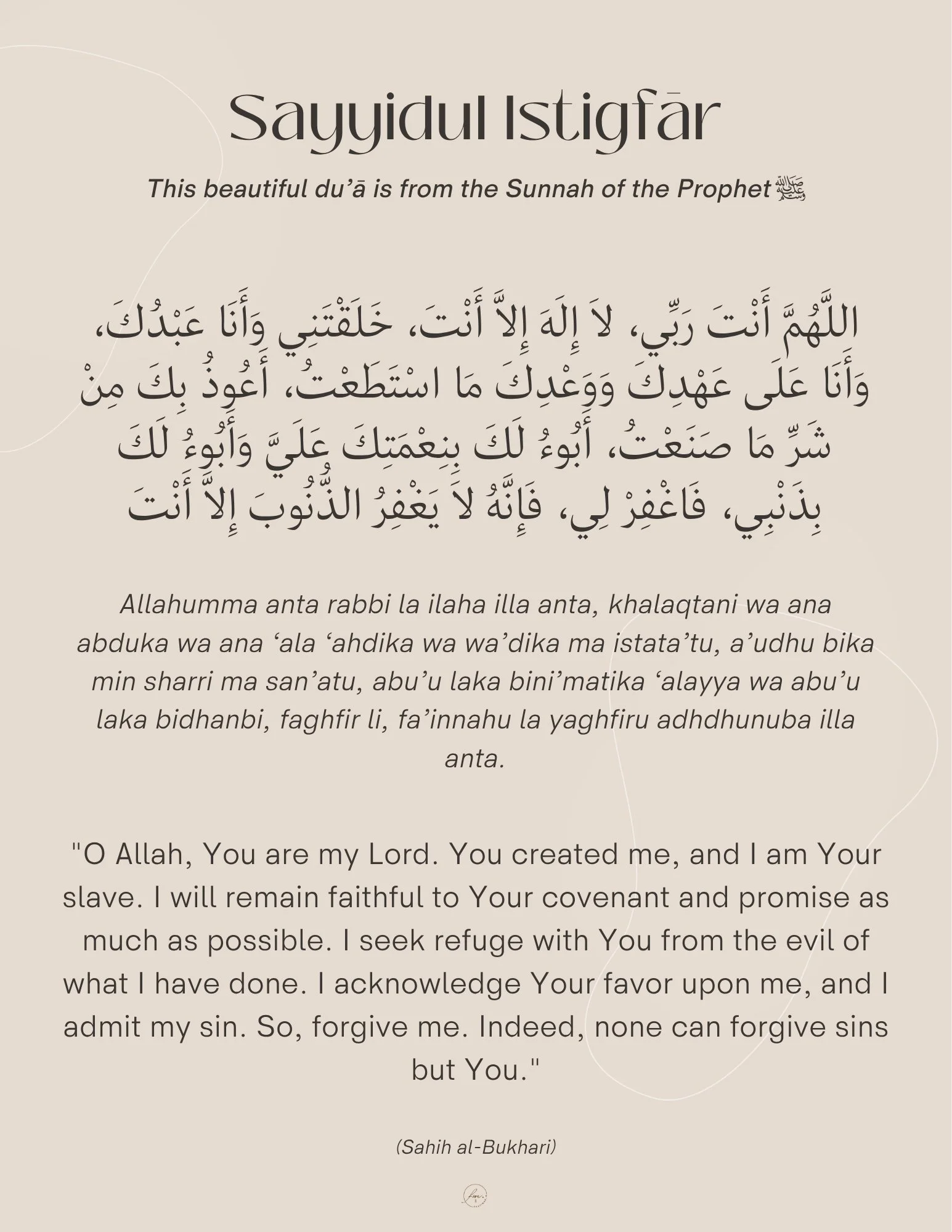
There is something deeply beautiful about the way the Prophet ﷺ taught us to seek forgiveness from Allah.
Sometimes, we think of istighfār as something we turn to when we have sinned. We say Astaghfirullah when we make a mistake, when we fall short, or when we feel guilty about something we have done.
And whilst seeking forgiveness is certainly a means of having our sins forgiven, istighfār is so much more than that.
It is a way of returning to Allah. A way of acknowledging our dependence on Him. A way of recognising that we cannot navigate this life, overcome our weaknesses, or even remain steadfast upon goodness without His help.
And amongst the most beautiful forms of seeking forgiveness is a du’ā known as Sayyidul Istighfār, the master supplication for forgiveness.
The Prophet ﷺ taught us that whoever recites it during the day with firm faith in its words and dies before the evening will be amongst the people of Jannah. And whoever recites it at night with firm faith in its words and dies before the morning will be amongst the people of Jannah. (Sahih al-Bukhari)
Pause for a moment and reflect on that.
A du’ā we can learn, memorise and incorporate into our daily lives, yet how much of its meaning have we truly allowed to settle into our hearts?
Let us look at what makes this du’ā so profound.
1. Acknowledging who Allah is
The du’ā begins by affirming that Allah is our Lord, that there is no deity worthy of worship except Him, and that He created us.
Before we ask for anything, we acknowledge who we are turning to.
This is important because sometimes, when life becomes difficult, our hearts become so consumed by what we need from Allah that we forget to reflect on who Allah is to us.
We become absorbed in the problem, the unanswered du’ā, the uncertainty, the fear, or the outcome we desperately want.
Sayyidul Istighfār brings our hearts back to the foundation of our relationship with Him.
He is our Creator. Our Lord. The One upon whom our existence depends.
We did not create ourselves. We do not possess complete knowledge of what is good for us. We cannot see what tomorrow holds, nor can we control every circumstance that shapes our lives.
Yet the One who created us knows us completely.
He knows the things we struggle to explain, the fears we conceal, the intentions behind our actions and the burdens we carry quietly.
When you recite this du’ā, remember that you are not turning to a distant stranger. You are turning to the Lord who created you, who knows you and who has invited you to seek His forgiveness.
2. Acknowledging our covenant with Allah
The du’ā then expresses that we remain committed to Allah’s covenant and promise as best we can.
There is a beautiful humility in this.
We are acknowledging that we belong to Allah and that our lives are meant to be lived in devotion to Him. We want to fulfil our responsibilities, obey His commands and live in a manner that pleases Him.
But we also recognise that we do not always get it right.
We may sincerely intend to change, only to find ourselves falling into the same habit again. We may promise ourselves that we will be more patient, only to lose our temper when we are overwhelmed. We may want to have greater trust in Allah, yet find ourselves consumed by worry when things do not go according to plan.
Sometimes, we know what we should do, but putting it into practice is a struggle.
This does not mean that our commitment to Allah is meaningless. It means that we must keep striving, keep seeking His help and keep returning to Him when we fall short.
Our relationship with Allah is not built upon pretending that we never struggle. It is built upon sincerity, obedience, repentance and a willingness to keep trying.
We are not claiming perfection when we recite this du’ā. We are acknowledging our commitment to Allah whilst recognising our need for His mercy and assistance.
3. Acknowledging the blessings Allah has given us
The next part of the du’ā acknowledges Allah’s blessings upon us.
Think about how easily we can become accustomed to the very things we once made du’ā for.
The home we prayed for. The health we took for granted. The people we love. The ability to wake up each morning, breathe, see, hear, walk, think and carry out our daily responsibilities.
Even the ability to recognise our mistakes, feel remorse and desire to become better is something worth reflecting upon.
How often do we count what is missing whilst overlooking what is present?
We may spend an entire day thinking about one unanswered du’ā, forgetting the countless ways Allah has already sustained us.
We may feel that our lives are not where they should be, yet fail to recognise how much Allah has carried us through.
Gratitude does not mean that we must deny our pain or pretend that everything is fine. You can be grateful to Allah and still be struggling. You can recognise His blessings and still cry over something that hurts.
Gratitude simply allows us to see that our pain is not the whole story.
When we acknowledge Allah’s blessings in Sayyidul Istighfār, we are reminded that even in our most difficult seasons, there are things for which we can thank Him.
And perhaps one of the greatest blessings is that, despite our shortcomings, Allah has given us the opportunity to turn to Him again.
4. Acknowledging our sins
The du’ā then moves into one of its most powerful moments. We acknowledge our sins before Allah.
Not the sins of other people. Not the ways others have disappointed us. Not the mistakes we can easily identify in our families, spouses, friends or communities.
Our own shortcomings.
This requires honesty.
It is easy to recognise the impatience of others whilst justifying our own. It is easy to speak about someone’s harshness whilst overlooking the harshness in our own words. It is easy to feel hurt by someone else’s behaviour without considering whether we have also caused hurt.
Perhaps we have spoken about someone in their absence. Perhaps we have allowed jealousy to take root in our hearts. Perhaps we have been ungrateful, neglected an obligation, spoken cruelly when angry, or allowed pride to prevent us from apologising.
Perhaps our sins are not visible to anyone else.
Perhaps they are the thoughts we entertain, the resentment we nurture, the private habits we struggle to leave behind, or the ways we repeatedly fall short of the person we want to become.
Sayyidul Istighfār invites us to stop running from the truth about ourselves.
But there is an important distinction here.
Acknowledging our sins is not the same as hating ourselves.
Repentance is not about convincing ourselves that we are worthless, beyond hope or undeserving of goodness. It is about recognising that we have done wrong and turning to the One who can forgive us.
Shame tells us to hide.
Sincere repentance invites us to return.
You do not have to pretend that your mistakes never happened. Nor do you have to allow them to define the rest of your life.
You can acknowledge what you did, take responsibility, make amends where necessary, seek forgiveness and work towards becoming better.
Your past may explain some of your struggles, but it does not have to dictate your future.
5. Seeking refuge in Allah from the consequences of our sins
The du’ā then acknowledges that no one can forgive sins except Allah.
Read that again and allow it to settle into your heart.
No one can forgive sins except Allah.
People may reassure us, but they cannot grant us Allah’s forgiveness. People may judge us, but their judgement does not determine whether Allah accepts our repentance. And even when we struggle to forgive ourselves, the door of sincere repentance remains something we should never despair of.
Sometimes, we carry the memory of a mistake for years.
We replay what happened. We wonder how we could have acted differently. We allow one chapter of our lives to become the lens through which we see ourselves.
We may have changed, but we continue punishing ourselves for who we once were.
If you have sincerely repented, taken responsibility for your actions and tried to make things right, do not confuse continued self-punishment with sincerity.
You can learn from your mistakes without living forever inside them.
You can remember what happened without allowing it to convince you that you are beyond Allah’s mercy.
And if you have wronged another person, seeking Allah’s forgiveness should also move you towards putting right what you can, respecting their rights and changing the behaviour that caused harm.
We cannot undo every mistake, but we can choose what we do with the awareness it has given us.
Turn to Allah. Ask Him to forgive you. Ask Him to help you become someone who no longer returns to the same patterns. And trust that His mercy is not limited by your ability to understand how forgiveness can be possible.
6. Acknowledging our dependence on Allah
Towards the end, we affirm that we turn to Allah with our sins and acknowledge His blessings upon us.
This is where the du’ā becomes especially moving.
We are not simply listing our wrongdoings. We are recognising that we need Allah.
We need His forgiveness for the things we have done. We need His guidance to recognise the things we have not yet realised are wrong. We need His help to change the habits we have struggled with for years.
We need Him when we are strong, and we need Him when we are weak.
We need Him when our worship feels easy, and we need Him when we struggle to find concentration in our prayers.
We need Him when we feel close to Him, and we need Him when our hearts feel distant.
Think of the person who repeatedly promises to stop reacting in anger, only to find themselves losing control when triggered.
They know what they want to change. They may even feel terrible afterwards. Yet knowing what needs to change and having the emotional capacity to change it are not always the same thing.
They need to seek forgiveness for their actions, but they also need to ask Allah for help in becoming more patient, learning to regulate their emotions, recognising their triggers and responding differently.
Or consider someone who has spent years making decisions out of fear. They want to trust Allah, but uncertainty makes them anxious. They understand that Allah is in control, yet their hearts struggle to live by that understanding.
They can use their istighfār as an opportunity to acknowledge their dependence on Allah, seek forgiveness for their shortcomings and ask Him to strengthen their trust.
Istighfār is not an alternative to taking the necessary steps to change. It is part of turning to Allah whilst doing the work He has placed within our responsibility.
We ask for forgiveness, and we ask for the strength to live differently.
We acknowledge our weaknesses, and we ask Allah to help us overcome them.
We recognise our dependence on Him, and we learn to stop expecting ourselves to navigate life through our own strength alone.
7. The beauty of ending with complete humility
The du’ā concludes by asking Allah to forgive us, for no one forgives sins except Him.
There is no arrogance here. No claim that we have done enough to deserve forgiveness. No belief that we are entitled to have every mistake overlooked.
There is only a servant turning to their Lord, acknowledging their shortcomings and asking for His forgiveness.
And perhaps this is one of the greatest lessons of Sayyidul Istighfār.
We do not approach Allah because we have perfected ourselves. We approach Him because we are His servants, and we need Him.
We do not wait until we have resolved every weakness before asking Him for help. We turn to Him whilst we are still struggling, whilst we are still learning, whilst we are still trying to understand ourselves and whilst we are still working towards becoming better.
The person who is struggling with their temper can turn to Him.
The person who has fallen into the same sin again can turn to Him.
The person who feels ashamed of their past can turn to Him.
The person who has neglected their spiritual connection and wants to rebuild it can turn to Him.
And the person who feels that they have so much to work on can begin with the very next recitation of this du’ā.
You do not have to wait until you feel worthy of asking Allah for forgiveness.
You ask because you need His forgiveness.
And you keep striving because you hope in His mercy.
Making Sayyidul Istighfār part of your daily life
The Prophet ﷺ taught us the virtue of reciting Sayyidul Istighfār in the morning and at night. We can make it a regular part of our daily routine, taking time to understand its meaning rather than allowing the words to pass over our tongues without reflection.
When you recite it in the morning, let it remind you of the relationship you want to nurture with Allah throughout your day.
Perhaps you will face a situation that tests your patience. Perhaps someone will upset you. Perhaps you will find yourself worrying about something beyond your control.
Remember the words you began your day with. Remember your commitment to Allah, His blessings upon you and your need for His help.
And if you fall short, return to Him.
When you recite it at night, allow yourself to reflect honestly on the day that has passed.
Where did you do well? Where did you fall short? Is there someone you need to apologise to? Is there a habit you need to work on? Is there a blessing you forgot to appreciate?
You do not need to turn every reflection into a list of your failures. Recognise your efforts too, thank Allah for His assistance and ask Him to forgive what was lacking.
Then let the day end with hope rather than endless self-reproach.
Remember, the virtue of Sayyidul Istighfār described in the hadith is connected to reciting it with firm faith in its words. It is not merely a formula to repeat mechanically whilst remaining indifferent to its meaning.
Let the words shape your awareness of Allah. Let them encourage you to live with greater sincerity. Let them remind you that repentance is not just something we say, but something that should gradually transform how we live.
And never assume that because you have recited it today, you no longer need to be mindful of your actions. Rather, allow it to renew your commitment to Allah.
A final reflection
Perhaps the most beautiful thing about Sayyidul Istighfār is that it brings together so many parts of our relationship with Allah.
Our recognition of who He is.
Our gratitude for what He has given us.
Our acknowledgement of where we have fallen short.
Our commitment to keep trying.
And our recognition that, ultimately, we need His forgiveness and mercy.
It reminds us that we can be grateful without pretending to be perfect, remorseful without losing hope, and committed to doing better without believing that we must do everything through our own strength.
So the next time you recite Sayyidul Istighfār, do not rush through it simply because you know the words.
Remember the Lord you are turning to.
Remember the blessings you have received.
Remember the mistakes you hope He will forgive.
Remember the person you are trying to become.
And remember that you are standing before the One who knows every part of your story, including the parts you struggle to face yourself.
You may not be able to change everything about yourself overnight. You may still have weaknesses to overcome, habits to unlearn and mistakes to make right.
But you can begin by turning to Allah sincerely.
And tomorrow, you can turn to Him again.
Not because your shortcomings do not matter, but because they matter enough for you to seek forgiveness and strive to change.
May Allah make us amongst those who remember Him often, recognise His countless blessings, acknowledge our shortcomings with sincerity and never lose hope in His mercy.
May He forgive the sins we remember and those we have forgotten, rectify our hearts, help us overcome our weaknesses and allow our istighfār to become a means of drawing closer to Him.
And may He grant us the beautiful ending promised to those who recite Sayyidul Istighfār with sincere faith.
Ameen.