

The Du’ā of Tawakkul
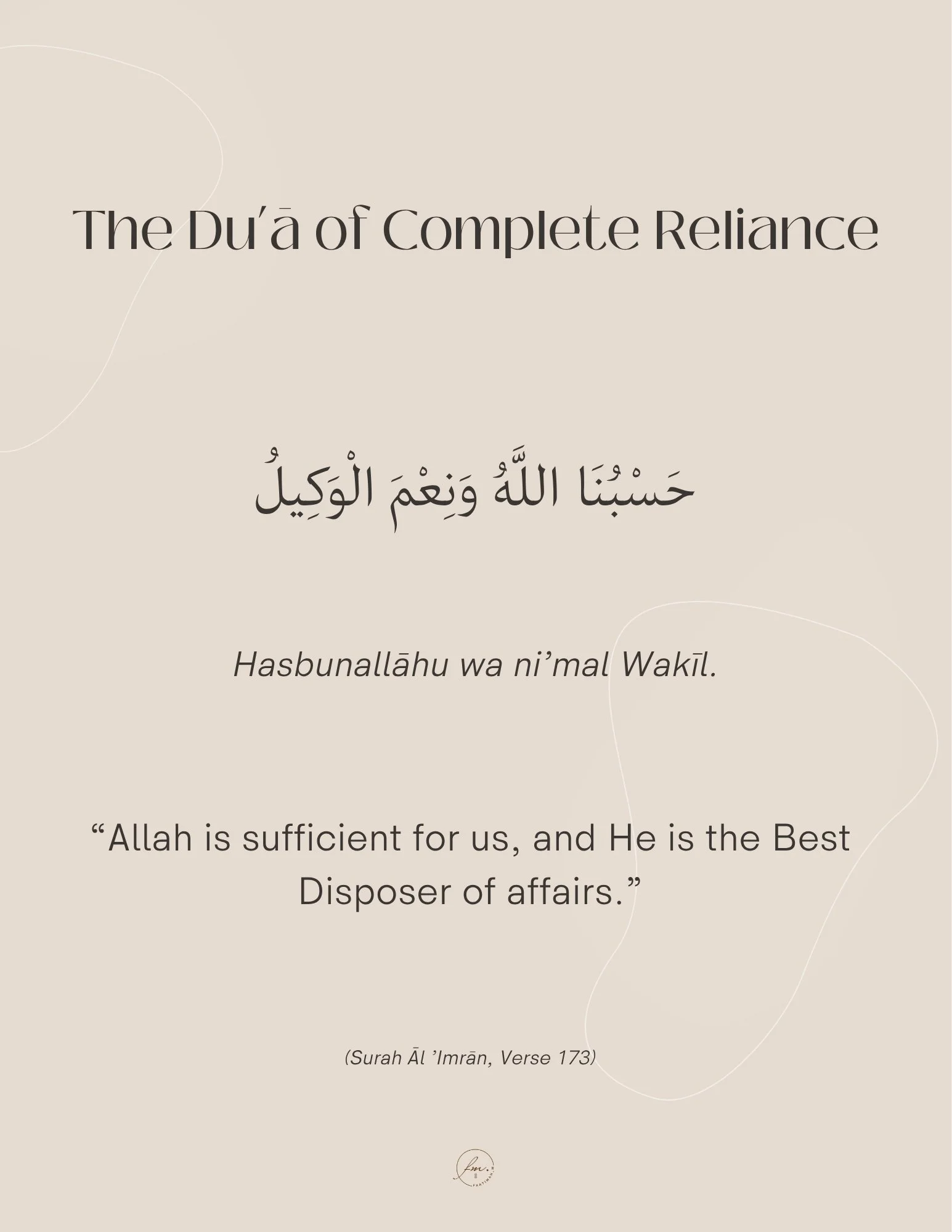
This is such a small du’ā, but it carries such a huge meaning.
And perhaps that is what makes it so powerful.
“Allah is sufficient for us.”
Not, “Everything will go exactly the way I want.”
Not, “Nothing bad will ever happen.”
Not, “I know how this is going to end.”
Simply:
Allah is sufficient for me.
That is tawakkul.
Tawakkul is not knowing what will happen and feeling completely unafraid.
It is not sitting back and doing nothing.
It is not expecting Allah to give us exactly what we ask for.
Tawakkul is doing what you can, while knowing that the outcome was never yours to control.
And this du’ā comes from a beautiful moment in the Qur’ān.
The believers were warned that people had gathered against them and that they should be afraid.
That news could have caused them to panic.
Instead, it increased their faith, and they said:
“Allah is Sufficient for us, and He is the Best Disposer of affairs.”
I think this is where tawakkul becomes real.
It is easy to say we trust Allah when everything is going according to plan.
But what happens when you receive the message you were dreading?
When the person does not respond?
When the relationship ends?
When the opportunity falls through?
When your plans suddenly change?
When you do not know how you will manage financially?
When you are waiting for an answer and your mind keeps creating ten different scenarios?
This is where we have to practise tawakkul.
Not by pretending that we are not worried.
But by reminding ourselves:
I do not know what will happen. Allah does.
I cannot control the outcome. Allah can.
I may not understand this. Allah does.
And there is another important part of tawakkul that we sometimes forget.
The believers did not hear the frightening news and simply sit at home saying, “Allah is sufficient.”
They responded.
They continued forward.
They did what was required of them.
Then they entrusted the outcome to Allah.
This is tawakkul.
Tie your camel, then trust Allah.
Make the effort.
Have the conversation.
Apply for the job.
Seek advice.
Set the boundary.
Take the necessary steps.
Make the du’ā.
Then release what was never in your hands to begin with.
Perhaps today, choose one thing you have been trying desperately to control.
Maybe it is someone’s decision.
Maybe it is your future.
Maybe it is your rizq.
Maybe it is something you have been overthinking for days.
Take a moment and say:
Ḥasbunallāhu wa niʿmal wakīl.
Say it slowly.
Say it when your mind starts racing.
Say it when fear begins taking over.
Say it after you have done everything within your ability.
And let it remind you:
I have Allah.
I do not need to know every detail of what comes next.
I do not need to control every outcome.
I just need to keep turning to the One who does.
May Allah strengthen our tawakkul, teach us to take the means without becoming dependent upon the means, and give our hearts the certainty to say, even when we cannot see the way forward,
“Allah is Sufficient for me, and He is the Best Disposer of affairs.”
The Du’ā of a Beautiful Ending
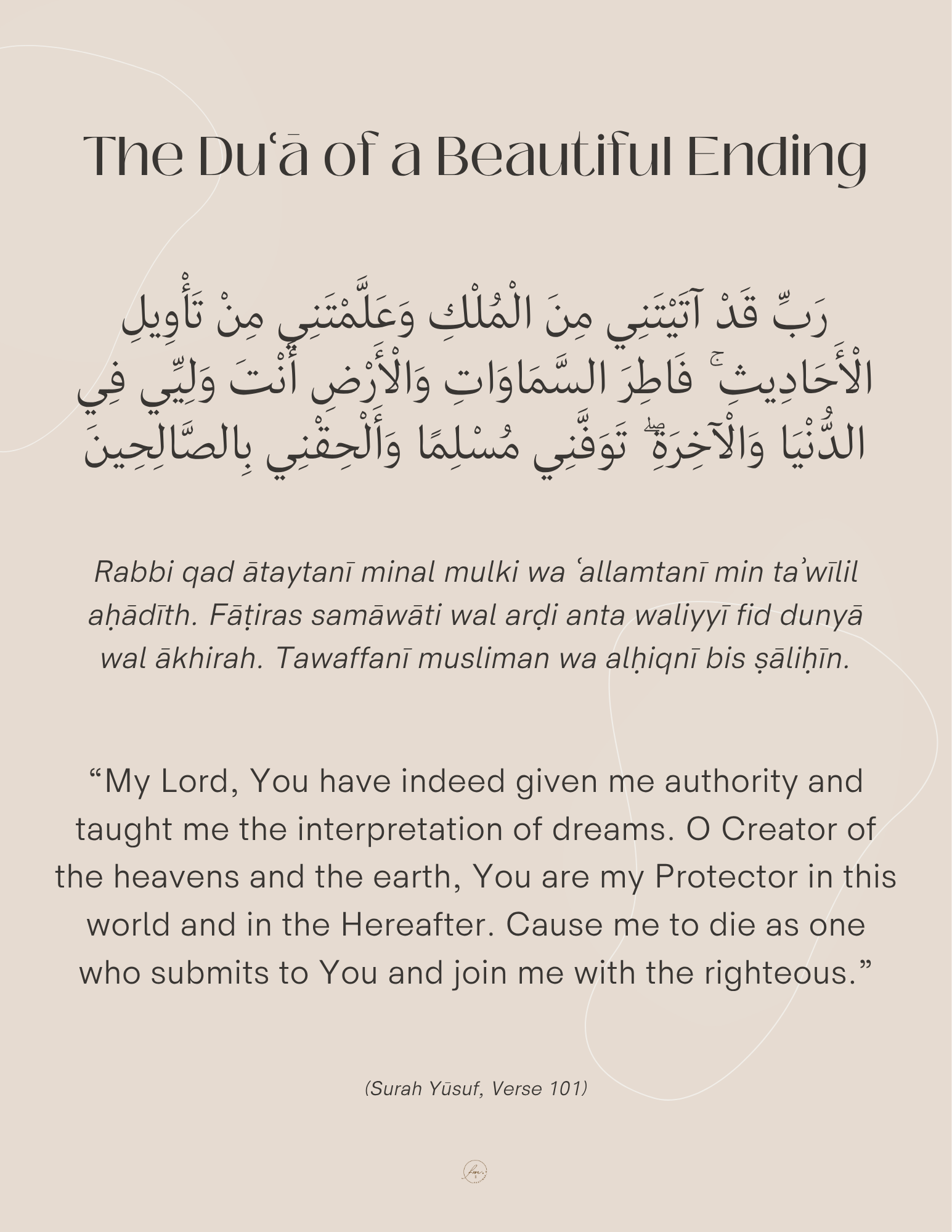
What makes this du’ā so different is when Yūsuf عليه السلام made it.
He had already been through so much.
He had been separated from his family.
He had been betrayed by his brothers.
He had been thrown into a well.
He had been taken away from his home.
He had experienced imprisonment.
And eventually, Allah elevated him.
He was given authority, knowledge and a position of influence.
Yet when he looked back at his life, he did not make his success the ending of his story.
He turned back to Allah.
And his greatest request was not:
“Allah, give me more.”
It was:
“Let me die as one who submits to You and join me with the righteous.”
There is something incredibly humbling about that.
We spend so much of our lives asking Allah to help us arrive somewhere.
To get married.
To build a career.
To become financially secure.
To heal.
To achieve something.
To reach a particular stage of life.
But Yūsuf عليه السلام reminds us that reaching the destination is not the ultimate goal.
The real goal is to reach Allah.
You can have everything you once prayed for and still be in need of Allah.
You can finally get the relationship you wanted and still need Allah.
You can become successful and still need Allah.
You can experience ease after years of difficulty and still need Allah.
Because the greatest blessing is not simply what Allah gives you in this dunya.
It is that whatever He gives you does not take you away from Him.
And perhaps this is something worth reflecting on today.
What if we started asking Allah not only for a beautiful life, but for a beautiful ending?
Not only:
“Ya Allah, let me experience happiness.”
But:
“Ya Allah, let me remain Yours through my happiness.”
Not only:
“Give me success.”
But:
“Let my success increase me in gratitude.”
Not only:
“Give me love.”
But:
“Let the love in my life bring me closer to You.”
Not only:
“Remove my difficulties.”
But:
“Do not let my difficulties take me away from You.”
Because we do not know how our story will unfold.
Yūsuf عليه السلام could not have imagined, when he was sitting in that well, the position Allah would eventually give him.
And we cannot see the entirety of our own story either.
There will be chapters we do not understand.
Chapters we wish we could skip.
Chapters we never expected.
And perhaps chapters that will surprise us with how beautifully Allah brings everything together.
But whatever our story contains, there is one thing we can keep asking for:
“Ya Allah, let me remain Yours.”
That is the prayer.
Not simply for a beautiful beginning.
Not simply for a beautiful middle.
But for a beautiful ending.
May Allah bless us with goodness in this world, protect our īmān through every season, make us grateful when He gives and patient when He withholds, and allow our final moments to be moments of complete submission to Him. Ameen 🤍
When You Just Want Allah
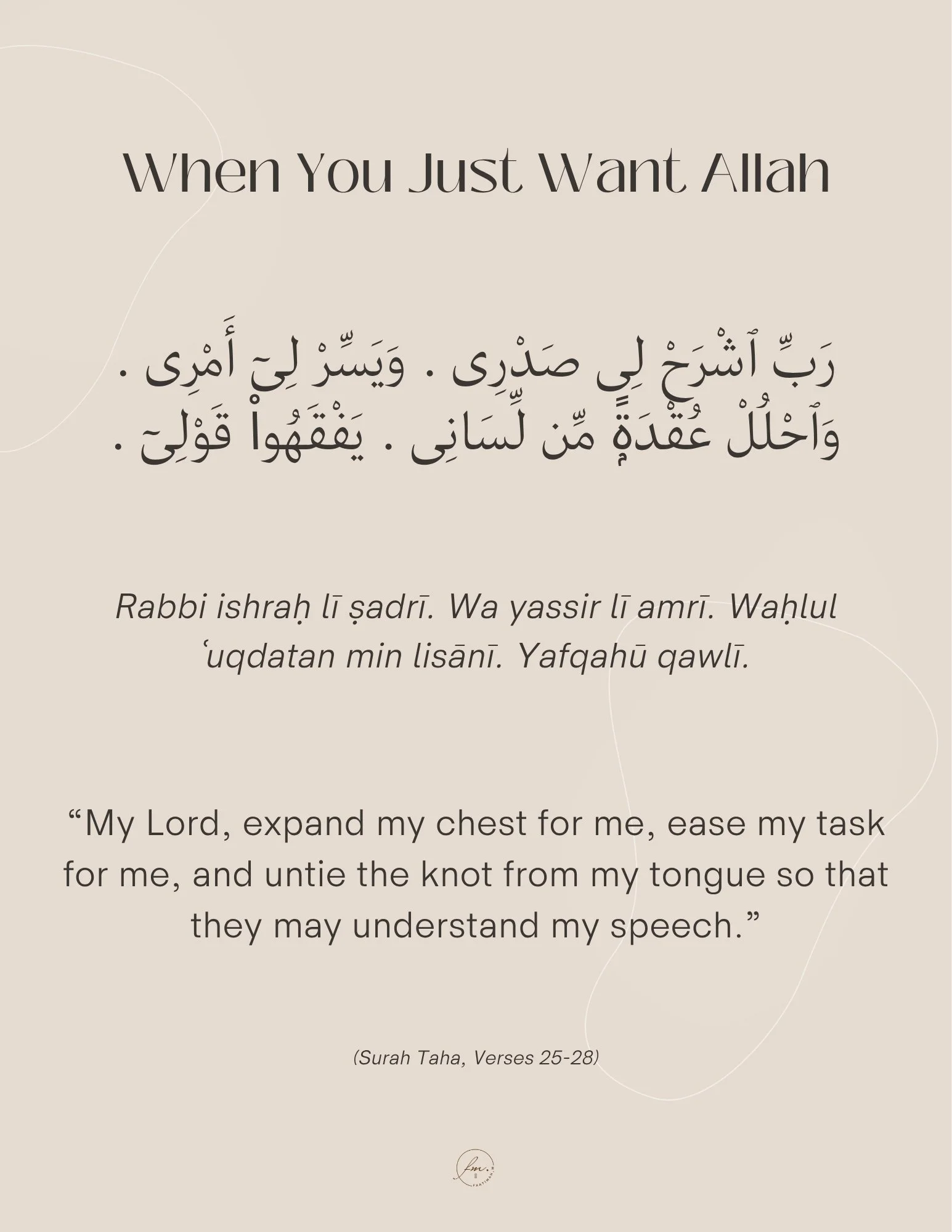
Mūsa عليه السلام was about to face something incredibly difficult.
He was being commanded to go to Firʿawn.
A man who had power.
A man who had oppressed his people.
A man Mūsa عليه السلام knew could be dangerous.
And what did Mūsa عليه السلام ask Allah for?
He asked for an expanded chest.
For ease.
For the ability to communicate clearly.
He did not ask to be made powerful.
He did not ask for everyone to agree with him.
He did not ask Allah to remove every difficulty before he began.
He asked Allah to prepare him for what was ahead.
And I think there is something deeply relevant here for us.
Sometimes we pray:
\“Allah, change my situation.”
But perhaps there are moments when the better prayer is:
“Allah, change what is happening within me as I move through this situation.”
When you have a difficult conversation, ask Allah to expand your chest.
When you have to stand up for yourself, ask Allah to give you the right words.
When you enter a new environment, ask Allah to ease your affairs.
When you feel misunderstood, ask Allah to untie the knots in your speech.
When you are nervous about something you have to face, ask Allah to give you an expanded heart before you walk into it.
Because sometimes the situation will not change immediately.
The person may still be difficult.
The conversation may still need to happen.
The responsibility may still be yours.
The decision may still have to be made.
But you can enter that moment differently.
With Allah.
And perhaps that is one of the most beautiful things about this du’ā.
Mūsa عليه السلام did not ask Allah to make the task disappear.
He asked Allah to make it easier for him to carry.
There are things in our lives that we cannot avoid.
We have to have the conversation.
We have to make the decision.
We have to begin again.
We have to walk into the unknown.
We have to let go.
We have to say no.
We have to speak.
We have to remain silent.
And sometimes we simply need Allah to give us the capacity to do what needs to be done.
So today, before the difficult conversation, before the meeting, before you send that message, before you make that decision, pause.
Take a breath.
And make this du’ā.
Ask Allah to expand your chest before asking Him to change the world around you.
Ask Him to ease your affairs.
Ask Him to give your tongue the right words.
Ask Him to allow your words to be understood.
And then walk forward.
You may still feel nervous.
You may still feel uncertain.
But you will know that you did not walk into that moment alone.
Mūsa عليه السلام walked towards one of the most powerful men of his time with a du’ā on his tongue.
And perhaps we can learn from him.
You do not always need more confidence. Sometimes you simply need more reliance upon Allah.
May Allah expand our hearts, ease what feels difficult, place wisdom upon our tongues, and give us the strength to face every situation in a way that pleases Him. Ameen 🤍
The Du’ā for Inner Peace
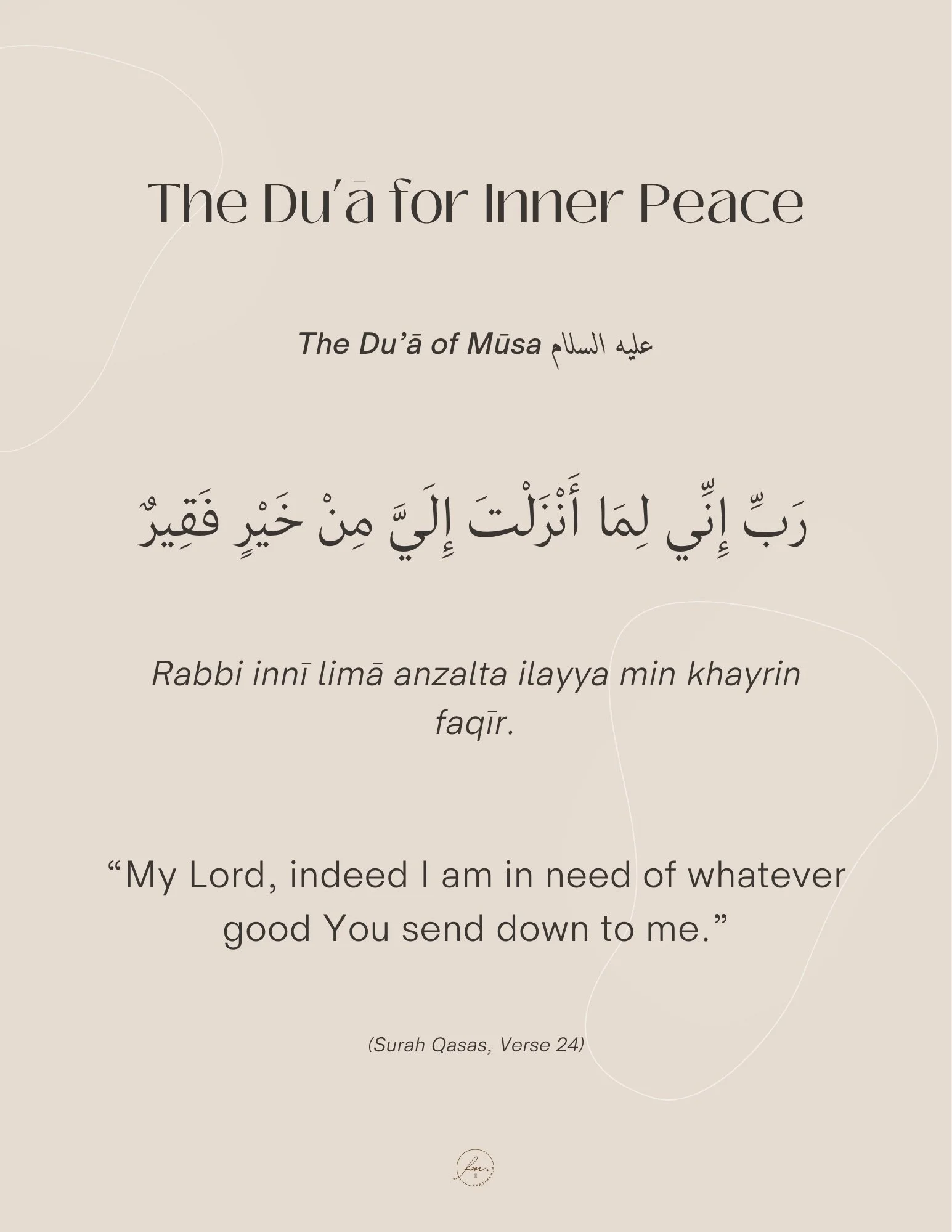
There is something very different about this du’ā.
Mūsa عليه السلام does not tell Allah what to give him.
He does not present a list.
He does not say, “Ya Allah, I need a home, a job, food, safety and companionship.”
He simply says:
“My Lord, I am in need of whatever good You send to me.”
There is such surrender in those words.
And perhaps that is something we need more of.
Because sometimes we become so attached to a particular version of our future that we forget Allah knows what we actually need.
We decide what the answer must look like.
We decide who it must come through.
We decide when it must happen.
We decide how quickly it should happen.
And then we become disappointed when Allah’s plan does not resemble ours.
But Mūsa عليه السلام teaches us another way.
“I am in need of whatever good You send to me.”
Not:
“Give me exactly what I have imagined.”
But:
“Send me whatever You know is good for me.”
There is a beautiful freedom in that.
You can make du’ā for marriage without deciding who Allah must send.
You can ask for financial ease without deciding exactly how it must come.
You can ask for healing without demanding that your journey look a certain way.
You can ask for a new beginning without knowing what that beginning will look like.
You can simply say:
“Ya Allah, I am in need of whatever good You send to me.”
And then remain open.
Because look at what happened to Mūsa عليه السلام after this du’ā.
He did not know what was coming.
He had no idea that the people he had just helped would become part of the next chapter of his life.
He did not know that his act of kindness would lead him to a place of safety.
He did not know that he would be offered work.
He did not know that he would eventually marry and build a life there.
One moment he was sitting beneath the shade, not knowing what would happen next.
And then Allah began opening doors.
Not all at once.
One door led to another.
One encounter led to another.
One opportunity led to another.
And eventually, Mūsa عليه السلام arrived at a future he could never have planned for himself.
Perhaps that is the part we need to remember.
You do not have to know what Allah is going to do next.
You only have to know that He does.
So perhaps today, instead of trying to tell Allah exactly how you want your life to unfold, sit with this duʿā.
Say it when you feel uncertain.
Say it when you are making a major decision.
Say it when you are tired of waiting.
Say it when you have no idea what you need.
Say it when your plans have fallen apart.
And most importantly, say it with an open heart.
“My Lord, I am in need of whatever good You send to me.”
Because Allah knows the good you cannot yet see.
He knows the doors you have not discovered.
He knows the people you have not met.
He knows the opportunities that have not arrived.
He knows the version of you that you have not yet become.
And sometimes the most beautiful thing we can do is stop trying to write the entire story ourselves and allow Allah to surprise us with His goodness.
May Allah send us goodness from places we never expected, open doors we never knew existed, and give us hearts that recognise His goodness when it arrives. Ameen 🤍
The Du’ā of Contentment
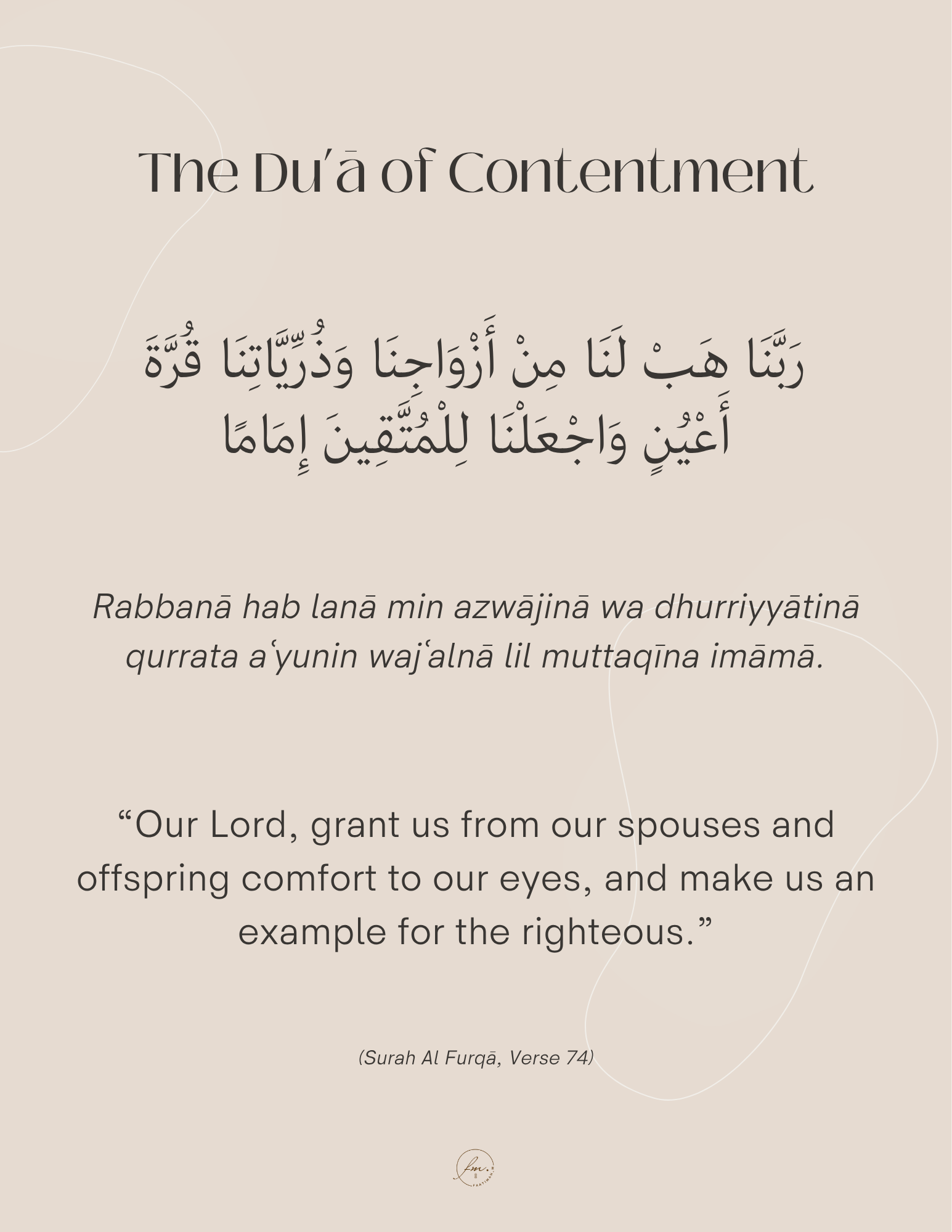
There is a particular part of this du’ā that I find so beautiful.
“Comfort to our eyes.”
Because we all have an idea of what we think will make us happy.
We think it will be the right person.
The beautiful home.
The successful career.
The financial security.
The children.
The achievement we have been working towards.
And there is nothing wrong with asking Allah for these things.
But this du’ā asks for something deeper.
It asks Allah to make the people and relationships in our lives a source of genuine comfort.
Not simply something that looks good from the outside.
Not simply a relationship that gives us a title.
Not simply a family that looks perfect on social media.
But people who bring tranquillity to our hearts and help us become closer to Allah.
And I think this is particularly meaningful for us as women.
Because sometimes we can become so attached to the idea of what our life is supposed to look like that we forget to ask whether what we are pursuing will actually bring peace to our hearts.
A marriage can look beautiful and still lack peace.
A friendship can be exciting and still leave you emotionally drained.
A home can be beautiful and still feel empty.
A life can look successful and still feel disconnected from Allah.
So perhaps instead of only asking:
“Allah, give me this person.”
We can also ask:
“Allah, give me someone who will be a comfort to my eyes.”
Someone whose presence brings me closer to You.
Someone with whom I can grow.
Someone who makes obedience easier, not harder.
Someone who brings mercy into my life.
And perhaps this applies beyond marriage too.
Ask Allah for friends who are a comfort to your eyes.
Family members who bring peace into your home.
Children who become a source of goodness.
People around you who remind you of Allah when you forget.
But then the du’ā takes an unexpected turn.
We do not only ask Allah to give us righteous people.
We ask Him to make us an example for the righteous.
That changes everything.
It is easy to pray for a righteous spouse.
But am I becoming a righteous spouse?
It is easy to pray for good children.
But am I becoming the kind of mother, aunt, teacher or woman whose character teaches goodness?
It is easy to ask Allah for good friends.
But am I becoming a good friend?
Sometimes we are so focused on asking Allah to send the right people into our lives that we forget to ask Him to make us the right person in someone else’s life.
And perhaps that is the real beauty of this du’ā.
It is not
“Allah, give me a beautiful life.”
It is:
“Allah, make the relationships You give me a source of goodness, and make me a source of goodness for others.”
So today, read this duʿā and think beyond marriage.
Think about the people Allah has already placed in your life.
Who brings you closer to Him?
Who makes your heart feel safe?
Who reminds you of your purpose?
And then ask yourself something uncomfortable but beautiful:
Am I that person for someone else?
May Allah bless us with relationships that are a comfort to our eyes, homes filled with mercy, friendships that bring us closer to Him, and hearts that become a source of comfort for others.
And may He make us women whose presence leaves people feeling closer to Allah, not further away from Him 🤍
The Du’ā of Gratitude
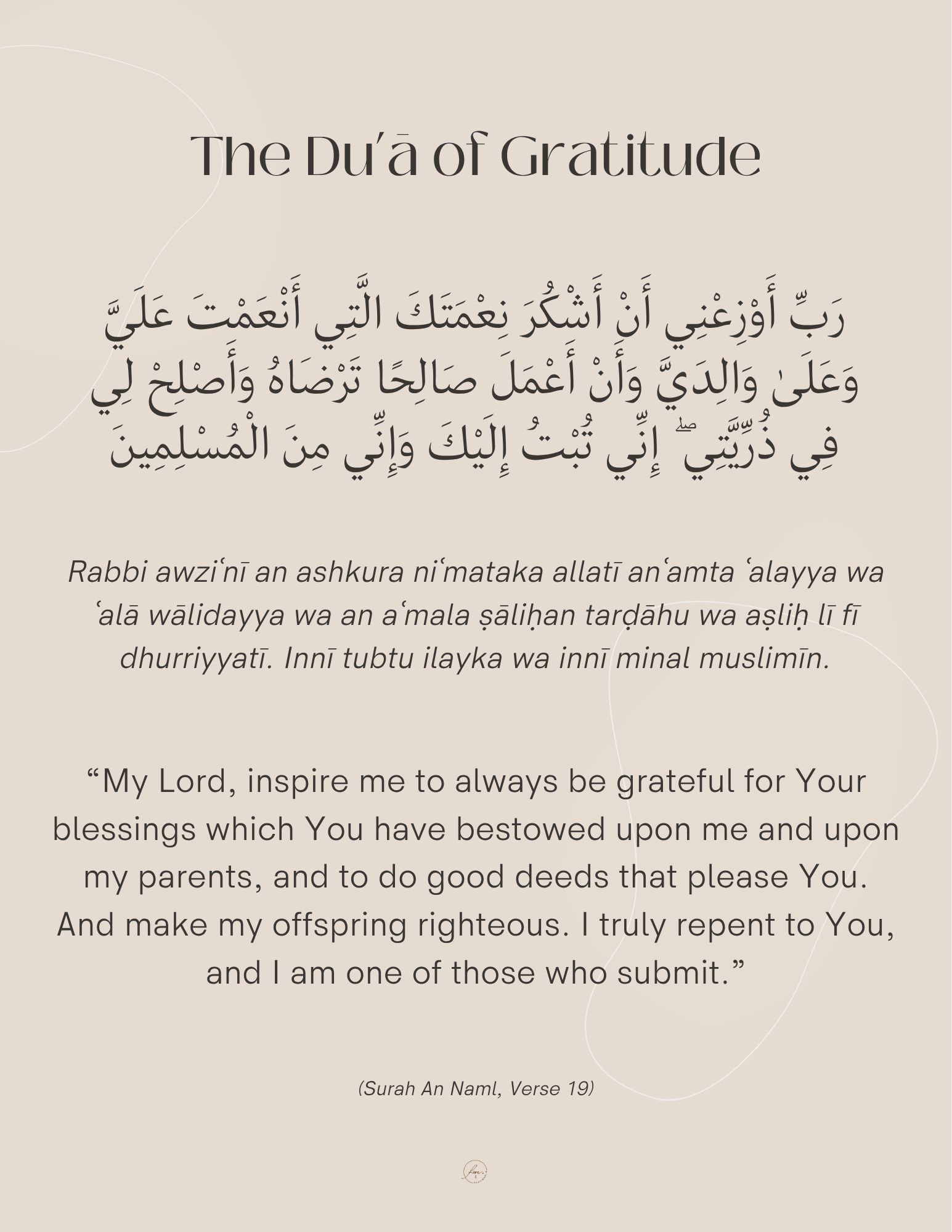
There is something so beautiful about the way Sulaymān عليه السلام looked at his blessings.
He had been given extraordinary things.
Power.
Wealth.
Knowledge.
Authority.
A kingdom unlike anything most people could imagine.
Yet when he witnessed something as small as an ant, his response was not arrogance.
It was gratitude.
And that makes me wonder:
How do we respond to the small blessings Allah places in our lives?
The cup of tea that comforts you at the end of a long day.
The friend who checks on you.
The ability to pray.
A safe home.
A body that carries you through your day.
The ability to laugh again after a difficult season.
A door that opened unexpectedly.
A door that closed and protected you.
A Qur’an that you can return to whenever your heart needs somewhere to rest.
We can become so focused on what we are waiting for that we forget to notice what Allah has already given us.
We say:
“When will my life change?”
“When will I get married, have children?”
“When will my finances improve?”
“When will I finally heal?”
“When will I receive what I have been making du’ā for?”
And sometimes, while waiting for the next blessing, we overlook the blessings already sitting quietly in our hands.
But look at the du’ā of Sulaymān عليه السلام.
He did not simply ask Allah for more.
He asked Allah to help him recognise and appreciate what he already had.
That is a completely different way of looking at life.
And then he asked for something even more beautiful.
He asked Allah to help him do good deeds that please Him.
Because blessings are not only things we enjoy.
They are also things we are responsible for.
If Allah gives you knowledge, how can you use it to benefit someone?
If He gives you wealth, who can you help?
If He gives you a platform, what are you using your voice for?
If He gives you emotional strength after a difficult season, who might need the encouragement you once needed?
If He gives you the ability to comfort people, whose heart can you make lighter?
And then Sulaymān عليه السلام asks Allah to rectify his offspring.
This is particularly beautiful for women who think about the impact they have on the generations after them.
Perhaps your legacy will not be something enormous that the world sees.
Perhaps it will be the way you taught someone to make du’ā.
The way you showed your daughter how to speak kindly.
The way you taught your son to respect women.
The way you made your home a place where Allah was remembered.
The way your nieces, nephews, students or younger sisters watched you turn to Allah during difficult moments.
We sometimes think a blessed life means having everything we want.
But perhaps a truly blessed life is one where Allah gives us the ability to recognise His blessings, be grateful for them and use them in ways that please Him.
So today, before asking Allah for the next thing, pause.
Look around you.
What has Allah already given you?
What have you survived?
What have you learnt?
Who has He placed in your life?
What abilities has He entrusted to you?
What blessings have become so familiar that you no longer notice them?
Then make this du’ā.
Ask Allah not only to bless your life, but to give you the heart to recognise the blessing.
Because sometimes the blessing is already there.
We simply need Allah to open our eyes to it.
May Allah make us women who notice His blessings, speak about them with gratitude, use them with responsibility and never allow abundance to make us forget the One who gave it to us. Ameen 🤍
The Du’ā for Truthful Speech
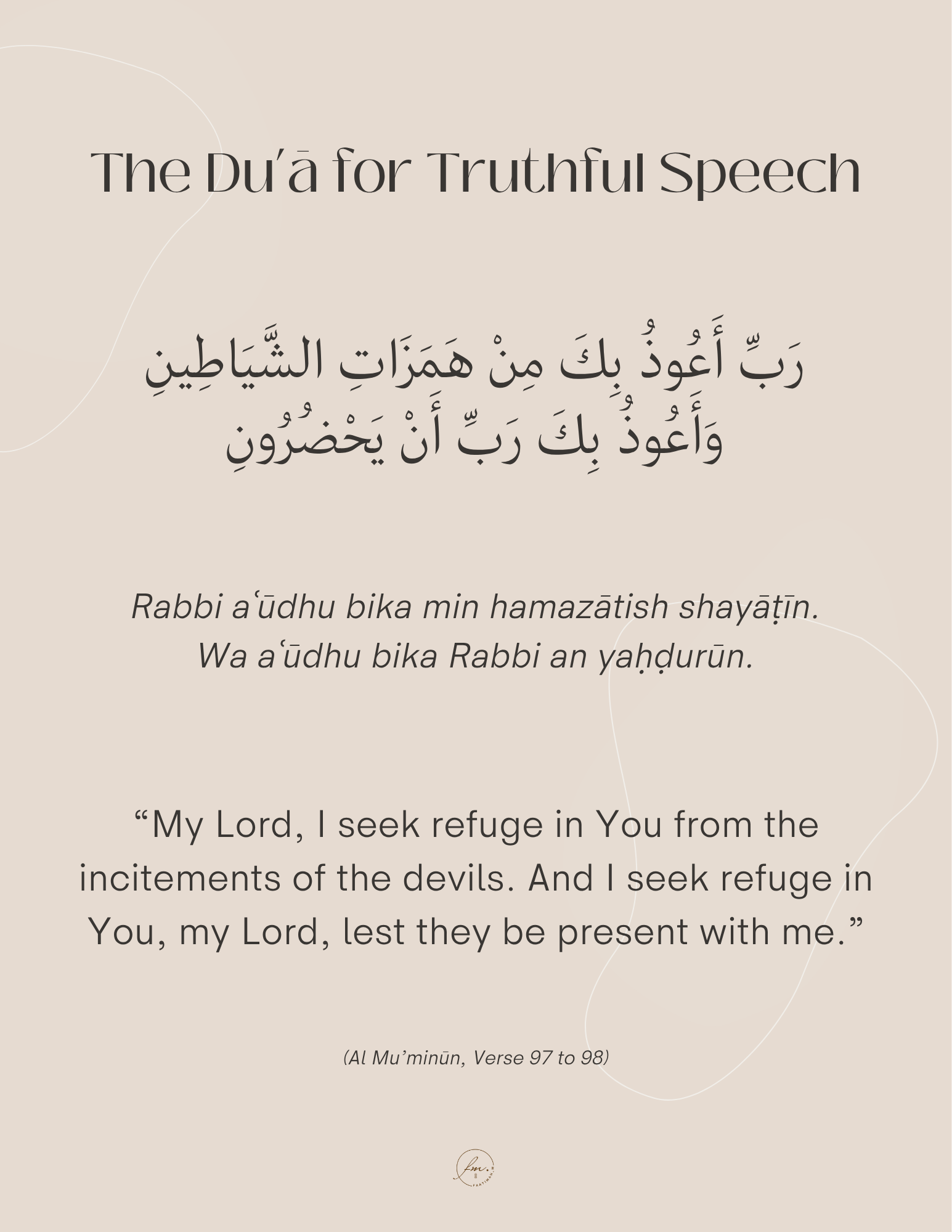
There are whispers we hear that nobody else does.
Not with our ears.
But in our hearts.
The whisper that tells you to respond with anger.
The whisper that encourages you to speak about someone when they are not there.
The whisper that says, “Send the message. They deserve it.”
The whisper that tells you to compare yourself with another woman until gratitude disappears.
The whisper that convinces you that you are not enough.
Or that someone else is worth less than you.
These whispers rarely arrive looking dangerous.
They sound reasonable.
They sound justified.
They sound like your own thoughts.
That is why this du’ā is so relevant.
It teaches us that not every thought deserves our attention.
Not every emotion deserves a reaction.
Not every feeling deserves to become words.
As women, we often spend time nurturing our homes, our families and our friendships.
But how often do we nurture the space between a thought and a response?
That brief moment where we choose whether to speak with kindness or criticism.
Whether to assume the best or the worst.
Whether to spread peace or spread negativity.
Perhaps our greatest act of worship today is not a lengthy prayer or an extra deed.
Perhaps it is choosing silence instead of gossip.
Patience instead of retaliation.
Gentleness instead of harshness.
The Prophet ﷺ taught us that words have weight.
A single sentence can mend a heart.
A single sentence can break one.
This du’ā reminds us to ask Allah to protect us before those whispers become actions, and before those actions become habits.
Because the strongest person is not always the one who wins an argument.
Sometimes the strongest person is the one who refuses to let shaytan write the next sentence that leaves their tongue.
May Allah protect our hearts from harmful whispers, our tongues from harmful words, and make our speech a source of mercy, wisdom and remembrance of Him. Ameen 🤍
The Du’ā for a Truthful Heart
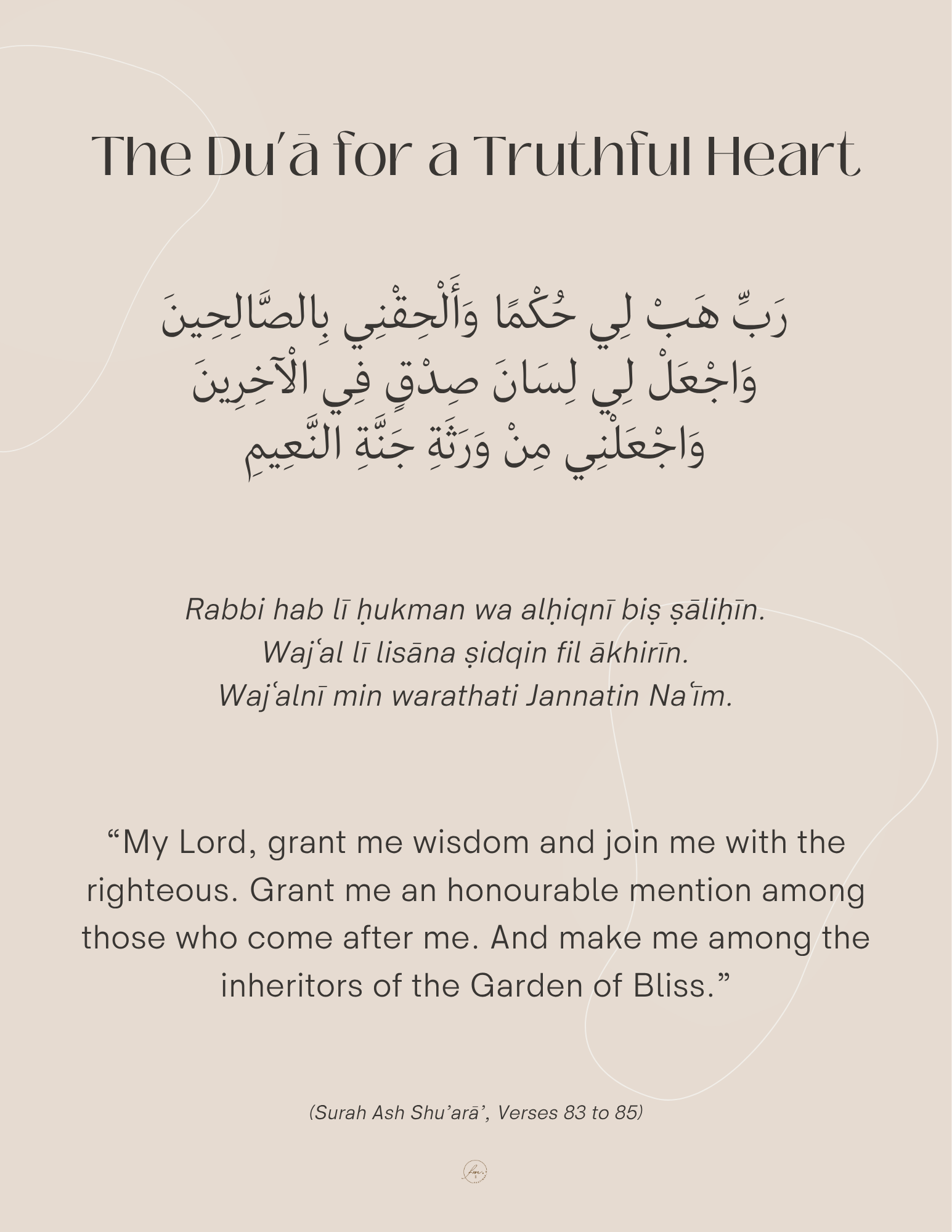
There is something refreshing about this du’ā.
It is not asking for wealth.
It is not asking for success.
It is not asking for an easier life.
Instead, it asks a question that we rarely stop to consider.
Who am I becoming?
We spend so much of our lives trying to build a career, a home, a family, a business or a reputation.
But how often do we think about building our character?
Ibrāhīm عليه السلام understood that the greatest achievement is not simply to be remembered.
It is to be remembered for goodness.
Imagine if people described us years from now.
Would they remember our appearance?
Our social media?
Our possessions?
Or would they remember how safe they felt around us?
How our words brought comfort.
How we reminded them of Allah.
How we treated people when nobody was watching.
This du’ā shifts our focus from having to becoming.
Instead of asking, “What can I gain?”
It teaches us to ask, “What kind of person am I becoming?”
As women, we often compare ourselves.
She is further ahead.
She is married.
She has children.
She has the business.
She has the perfect home.
She seems to have it all together.
But Allah is not comparing your timeline with hers.
He is looking at your heart.
He is looking at your sincerity.
He is looking at the quiet acts of goodness that nobody else will ever know about.
Perhaps success is not becoming the most admired person in the room.
Perhaps success is becoming the person whose character reflects the beauty of Islam.
The person who forgives.
The person who keeps their promises.
The person who speaks gently.
The person who is honest when dishonesty would be easier.
The person who leaves every place better than they found it.
That is a legacy worth praying for.
Because when this life ends, our possessions stay behind.
Our titles disappear.
Our followers vanish.
But our character continues to speak on our behalf.
May Allah grant us wisdom, surround us with righteous people, make us women whose lives point others towards Him, and leave behind a legacy that continues to benefit us long after we return to Him. Ameen 🤍
The Du’ā for Consistency in Worship
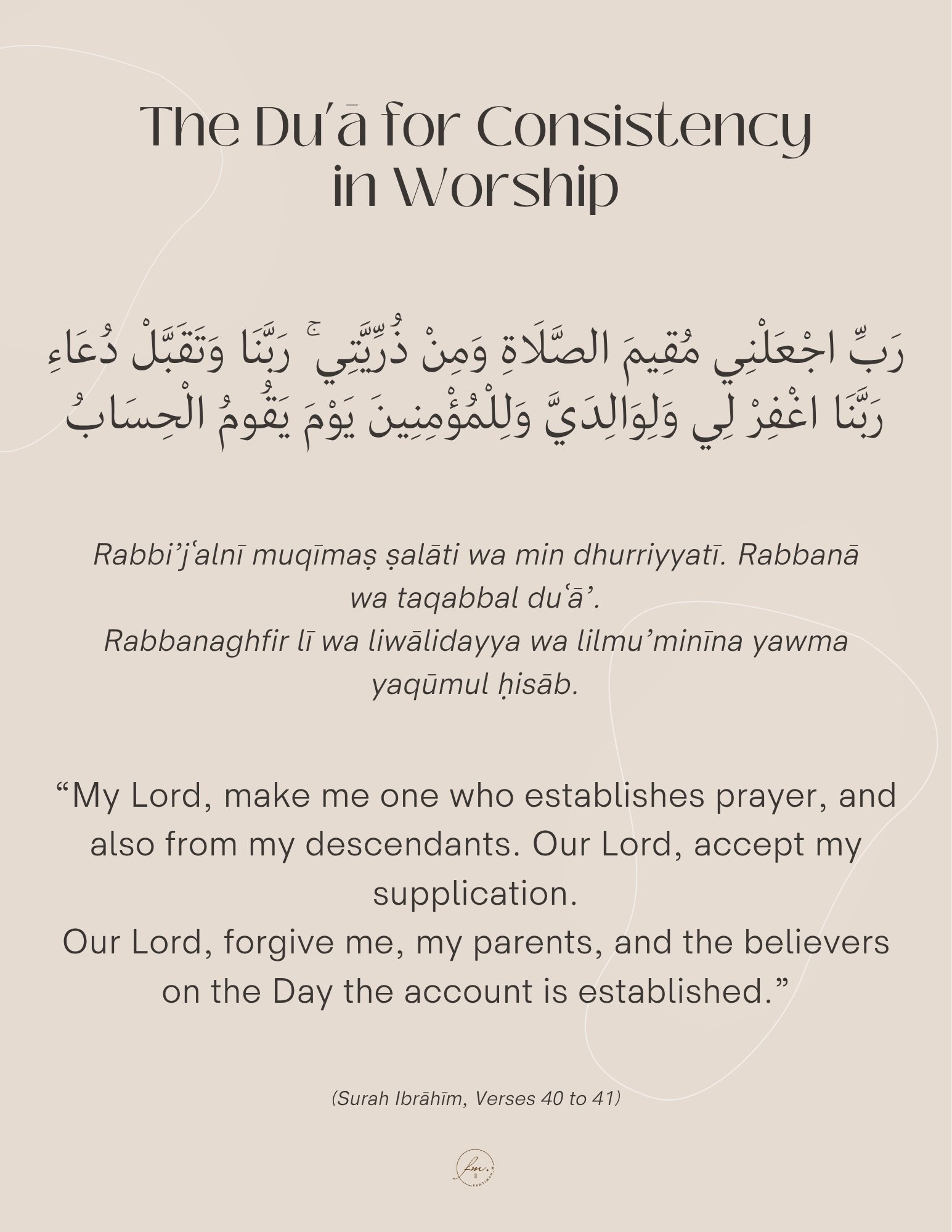
There is something so humbling about this du’ā.
It was made by Ibrāhīm عليه السلام, one of the greatest Prophets, a man whose faith and obedience are an example for all of humanity.
Yet even he did not rely on himself to remain steadfast.
He asked Allah to make him someone who established Salaah.
That teaches us something profound.
Consistency in worship is not simply about discipline.
It is a gift from Allah.
Sometimes we tell ourselves, “I just need to be more motivated.”
“I need to try harder.”
“I need to be more organised.”
While effort is important, this du’ā reminds us that our ability to worship Allah consistently is itself a blessing that we should ask Him for.
There are seasons in life when worship feels effortless.
Then there are seasons when even the smallest act of worship requires determination.
Perhaps you have experienced days when your heart felt alive in Salaah.
And perhaps you have also experienced days when your mind wandered, your energy was low, or your routine was disrupted.
That does not mean you have failed.
It means you are human.
Instead of becoming discouraged, ask Allah to help you remain constant.
Notice too that Ibrāhīm عليه السلام did not stop with himself.
He immediately made du’ā for his descendants.
It is a beautiful reminder that our worship is never only about us.
Every prayer we establish, every act of obedience we preserve, has the potential to influence those around us.
Whether you are a mother, an aunt, a sister, a daughter, a teacher or simply a friend, your consistency can become a source of inspiration for someone else.
And the du’ā ends with forgiveness.
After asking for steadfastness in worship, Ibrāhīm عليه السلام asks Allah to forgive him, his parents and all the believers.
It reminds us that no matter how much we worship, we will always remain in need of Allah’s mercy.
Perhaps today, instead of asking Allah to make your life easier, ask Him to make your connection with Him stronger.
Because when your relationship with Allah is strong, you carry that strength into every other part of your life.
May Allah make us among those who establish Salaah with sincerity, remain steadfast in worship through every season of life, and leave behind a legacy of faith that continues long after we are gone. Ameen 🤍
The Du’ā for a Heart That Stays Firm
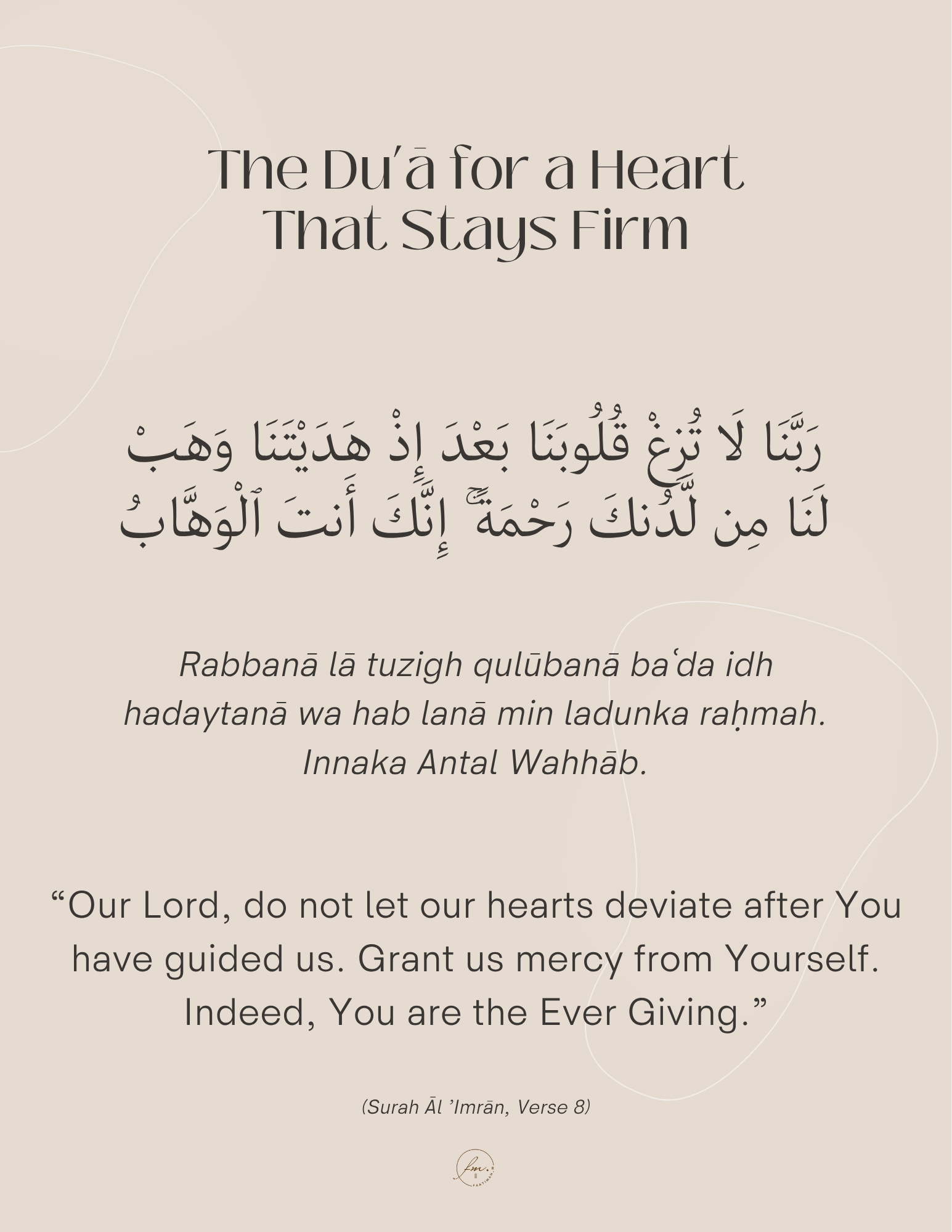
There is a common misconception that once a person is guided, the journey is complete.
But the Qur’ān teaches us something very different.
Even those who have found guidance continue asking Allah to keep their hearts firm.
Because guidance is not a destination.
It is something we ask Allah to preserve every single day.
Our hearts are constantly changing.
One day they feel full of īmān.
The next they feel distracted.
One day we wake up eager to pray, read Qur’ān and remember Allah.
Another day we struggle to find the same motivation.
This does not necessarily mean we are failing.
It means we are human.
That is why this du’ā is so beautiful.
It teaches us not to place our trust in our own consistency, discipline or willpower.
It teaches us to place our trust in the One who controls the hearts.
As women, our lives often move through many different seasons.
We experience joy and loss.
Moments of certainty and moments of confusion.
With every season, our hearts are tested in different ways.
Some hearts become harder through pain.
Some become distracted through comfort.
Some become tired through disappointment.
This du’ā reminds us that the greatest blessing is not simply finding guidance once.
It is remaining upon it until we meet Allah.
So instead of only asking Allah to change our circumstances, perhaps we should also ask Him to protect the heart that experiences those circumstances.
Because a heart that remains connected to Allah can withstand almost anything.
May Allah keep our hearts firm upon His guidance, increase us in His mercy, and never allow our hearts to drift away after He has brought us close to Him. Ameen 🤍
The Du’ā for Strength and Steadfastness
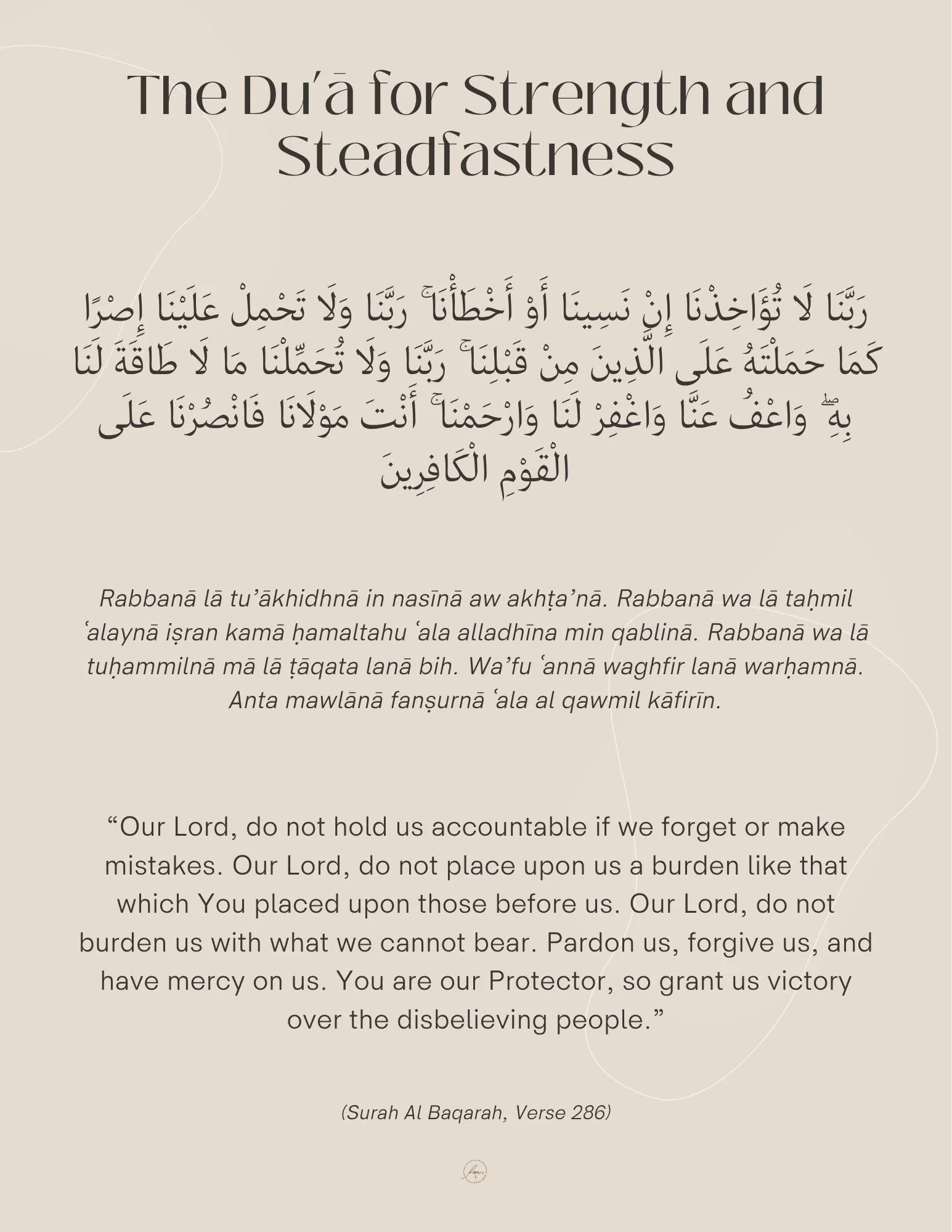
“You do not have to carry every burden alone. The One who allowed the test is the One who carries you through it.”
📖 Surah Al Baqarah (2), Verse 286
The Du’ā
رَبَّنَا لَا تُؤَاخِذْنَا إِنْ نَسِينَا أَوْ أَخْطَأْنَا ۚ رَبَّنَا وَلَا تَحْمِلْ عَلَيْنَا إِصْرًا كَمَا حَمَلْتَهُ عَلَى الَّذِينَ مِنْ قَبْلِنَا ۚ رَبَّنَا وَلَا تُحَمِّلْنَا مَا لَا طَاقَةَ لَنَا بِهِ ۖ وَاعْفُ عَنَّا وَاغْفِرْ لَنَا وَارْحَمْنَا ۚ أَنْتَ مَوْلَانَا فَانْصُرْنَا عَلَى الْقَوْمِ الْكَافِرِينَ
Transliteration
Rabbanā lā tu’ākhidhnā in nasīnā aw akhṭa’nā. Rabbanā wa lā taḥmil ʿalaynā iṣran kamā ḥamaltahu ʿala alladhīna min qablinā. Rabbanā wa lā tuḥammilnā mā lā ṭāqata lanā bih. Wa’fu ʿannā waghfir lanā warḥamnā. Anta mawlānā fanṣurnā ʿala al qawmil kāfirīn.
Translation
“Our Lord, do not hold us accountable if we forget or make mistakes. Our Lord, do not place upon us a burden like that which You placed upon those before us. Our Lord, do not burden us with what we cannot bear. Pardon us, forgive us, and have mercy on us. You are our Protector, so grant us victory over the disbelieving people.”
There are seasons in life when this du’ā feels especially close to the heart.
When you are trying your best but still making mistakes.
When you are emotionally exhausted.
When you are carrying responsibilities that nobody else sees.
When you feel weak, overwhelmed or afraid.
What is beautiful about this du’ā is that Allah Himself taught it to us. It acknowledges our humanity. We forget. We make mistakes. We become tired. We struggle. And yet we are taught to turn to Allah with hope, not shame.
Many women silently carry burdens that others do not see.
The burden of motherhood.
The burden of loneliness.
The burden of divorce, grief or heartbreak.
The burden of widowhood.
The burden of isolation.
The burden of unworthiness, insecurity, guilt, shame, fear, abandonment, rejection…
The burden of illness or struggling health.
The burden of caring for everyone else while neglecting themselves.
The burden of anxiety and overthinking.
This du’ā reminds us that we do not have to pretend to be strong all the time. We can admit our weakness before Allah and ask Him for help, forgiveness and mercy.
And perhaps one of the most comforting reminders is this:
If Allah tells us to ask Him not to burden us with more than we can bear, then it means that whatever He has allowed into our lives, He knows we can survive it through His help.
Not because we are strong on our own.
But because He is.
The Du’ā for When Life Feels Heavy
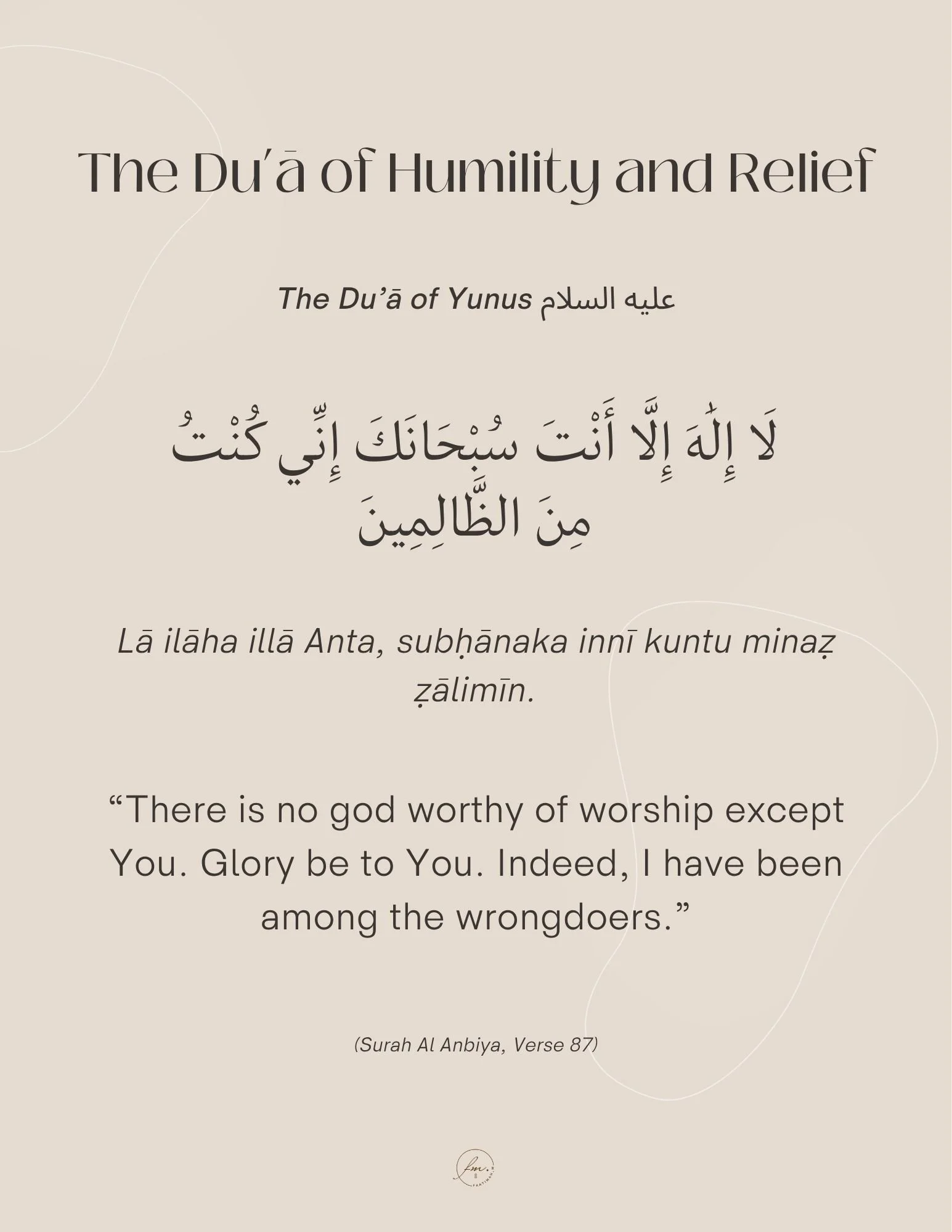
A beautiful du’ā that resonates deeply with many women is the du’ā of Yunus عليه السلام:
لَا إِلَٰهَ إِلَّا أَنْتَ سُبْحَانَكَ إِنِّي كُنْتُ مِنَ الظَّالِمِينَ
Lā ilāha illā Anta, subḥānaka innī kuntu minaẓ ẓālimīn.
“There is no god worthy of worship except You. Glory be to You. Indeed, I have been among the wrongdoers.” (Qur’an 21:87)
This du’ā is beautiful because it is not a direct request. Yunus عليه السلام does not ask for rescue, relief or a way out. Instead, he turns completely to Allah with humility, recognising Allah’s perfection and his own shortcomings.
Many of us can relate to moments where we feel trapped.
Trapped by anxiety.
Trapped by guilt.
Trapped by overthinking.
Trapped in a difficult marriage.
Trapped in grief.
Trapped by circumstances we cannot change.
Sometimes the situation itself is not even the hardest part. The hardest part is feeling alone in it.
Yunus عليه السلام made this du’ā from the depths of darkness. Yet before Allah changed his circumstances, there was first a turning back to Allah.
This du’ā teaches us that our way back to peace is not through having all the answers. It is through turning to Allah.
One of the most beautiful lessons from this story is that Allah did not only remove Yunus عليه السلام from the whale. Allah removed him from the darkness surrounding him.
And many of us are asking Allah to remove a difficulty while forgetting to ask Him to remove the darkness that the difficulty has created within us.
The darkness of fear.
The darkness of hopelessness.
The darkness of guilt.
The darkness of believing that things will never change.
When we read this du’ā, we are reminding ourselves that no situation is beyond Allah’s mercy.
The One who heard Yunus عليه السلام from within the belly of the whale, beneath the ocean, in layers of darkness, hears every whispered du’ā from our hearts too.
The Du’ā of Need, Trust and Divine Provision
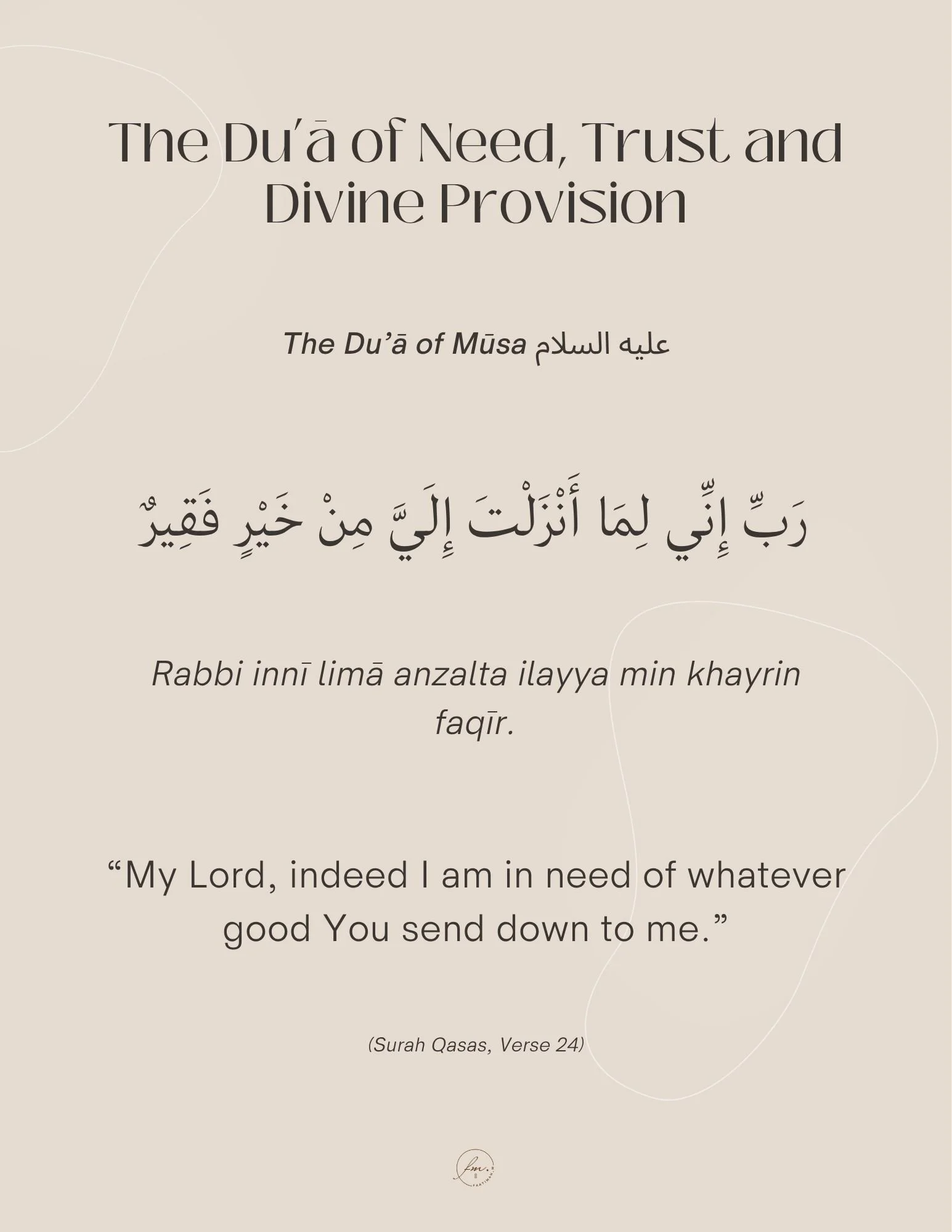
This is one of the most beautiful du’ās in the Qur’ān because of how simple, vulnerable and relatable it is.
Mūsa عليه السلام was not sitting in comfort when he made this du’ā.
He was alone.
He had fled Egypt.
He had no home.
No family around him.
No wealth.
No job.
No clear plan.
No certainty about what would happen next.
He had just helped two women water their flock, then moved into the shade and turned to Allah.
Notice something beautiful.
He did not tell Allah exactly what he wanted.
He did not ask specifically for money, a job, food, companionship, marriage or a place to stay.
He simply acknowledged his need.
“My Lord, I am in need of whatever good You send to me.”
There is something incredibly powerful about reaching a point where you stop trying to control the outcome and simply admit your need before Allah.
Many of us can resonate with this.
Perhaps you are in need of emotional healing.
Perhaps you are in need of peace after a painful divorce.
Perhaps you are in need of a righteous spouse.
Perhaps you are in need of financial ease.
Perhaps you are in need of guidance, clarity, purpose or strength.
Perhaps you cannot even put into words what you need.
This du’ā covers it all.
It is the du’ā of someone who recognises that every form of goodness ultimately comes from Allah.
What I find especially beautiful is how Allah answered this du’ā.
Allah did not suddenly drop everything into Mūsa’s lap.
The answer unfolded gradually.
First, he met the two women.
Then one of them returned and invited him to meet their father.
Then he was offered safety and hospitality.
Then he was offered work.
He worked for years.
And eventually, he was blessed with marriage and a home.
The goodness came.
But it came through a process.
A process that required patience, trust and continued effort.
This is something many of us forget.
We make du’ā and expect the answer to appear immediately.
When it does not, we assume Allah is not answering.
But the story of Mūsa عليه السلام teaches us that Allah’s response may already be unfolding even when we cannot yet see the full picture.
The person you meet today may be part of the answer.
The opportunity that appears next month may be part of the answer.
The healing journey you are currently on may be part of the answer.
The lesson you are learning right now may be preparing you for the answer.
Allah’s answers are not always instant, but they are always precise.
So if you find yourself feeling lost, uncertain, lonely or in need of goodness, return to this beautiful du’ā.
Read it with presence.
Read it with sincerity.
Read it knowing that the One who answered Mūsa عليه السلام is the same Allah who hears you today.
And trust that even if you cannot see it yet, your answer may already be unfolding.
The Du’ā That Teaches Us Balance
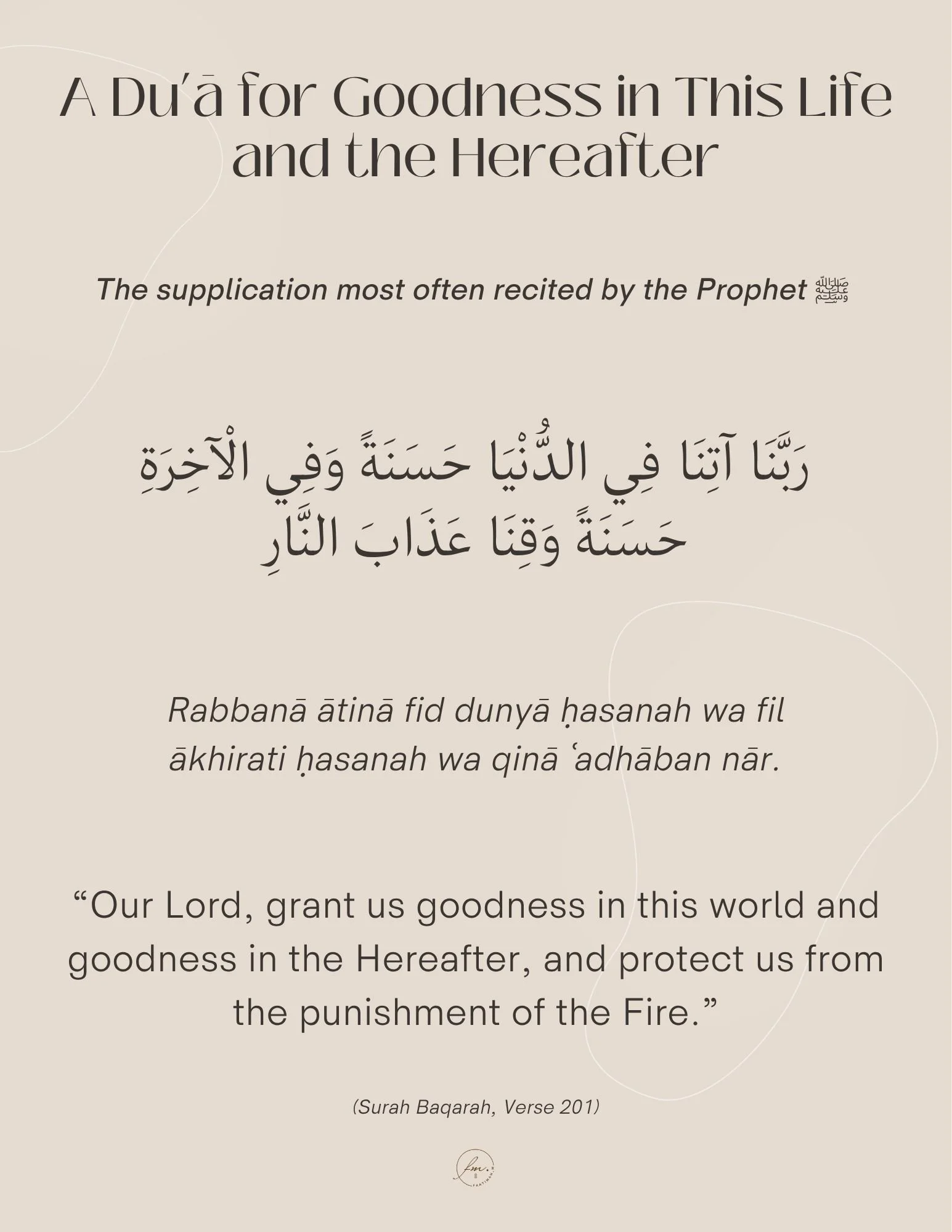
One of the most beloved and powerful du’ās in the Qur’an is:
رَبَّنَا آتِنَا فِي الدُّنْيَا حَسَنَةً وَفِي الْآخِرَةِ حَسَنَةً وَقِنَا عَذَابَ النَّارِ
Rabbanā ātinā fid dunyā ḥasanah wa fil ākhirati ḥasanah wa qinā ʿadhāban nār.
“Our Lord, grant us goodness in this world and goodness in the Hereafter, and protect us from the punishment of the Fire.”
There is something deeply beautiful about this du’ā because it teaches us balance.
Sometimes we think being close to Allah means we should completely detach from dunya, ignore our emotional needs, suppress our pain, or feel guilty for wanting ease, happiness, love or fulfilment.
But this du’ā shows us that Allah allows us to ask for goodness in both worlds.
Not only the Hereafter.
But this life too.
And perhaps this is why this du’ā resonates so deeply with so many women.
Because many women are silently trying to survive emotionally while also trying to stay spiritually connected.
Some are asking Allah for healing after heartbreak.
Some are asking Allah for peace in their homes.
Some are longing for righteous spouses.
Some are carrying anxiety about the future.
Some are struggling financially.
Some are trying to become better mothers.
Some are trying to rediscover themselves after years of pouring into everyone else.
Some simply want to feel emotionally safe again.
And Allah does not shame us for these desires.
This du’ā reminds us that it is okay to ask Allah for a beautiful life while still longing for Jannah.
“Goodness in this world” can mean so many things.
A heart that finally feels at peace.
Halal love that feels safe.
Healing from trauma.
Barakah in your home.
Softness in your heart.
Rizq that brings ease.
Good company.
Contentment.
Closeness to Allah.
A life filled with meaning.
And “goodness in the Hereafter” is even greater.
To stand before Allah with a heart that tried.
To be forgiven despite our flaws.
To be reunited with those we love.
To enter Jannah through His mercy.
This du’ā is not just about asking Allah for things.
It is about recognising that every form of goodness comes from Him.
And perhaps one of the most emotional parts of this du’ā is that it teaches us that we are allowed to want both.
To want closeness to Allah and emotional healing.
To desire Jannah and also pray for a life filled with peace and barakah.
To seek spirituality without neglecting our human hearts.
Especially during the days of Dhul Hijjah, this du’ā becomes even more meaningful.
These are days where hearts soften.
Where people return to Allah.
Where du’ās are accepted.
Where we reflect on the legacy of Ibrahim عليه السلام, sacrifice, trust and complete surrender to Allah.
So ask Allah for goodness in every part of your life.
Goodness in your heart.
Goodness in your healing.
Goodness in your relationships.
Goodness in your future.
Goodness in your akhirah.
Because Allah is not limited in what He can give.
And no matter how broken, lost or exhausted you feel, His door remains open, His mercy remains vast, and His ability to transform your life remains greater than anything you can imagine.
The Du’ā of Ibrahim عليه السلام for Steadfastness in Salaah
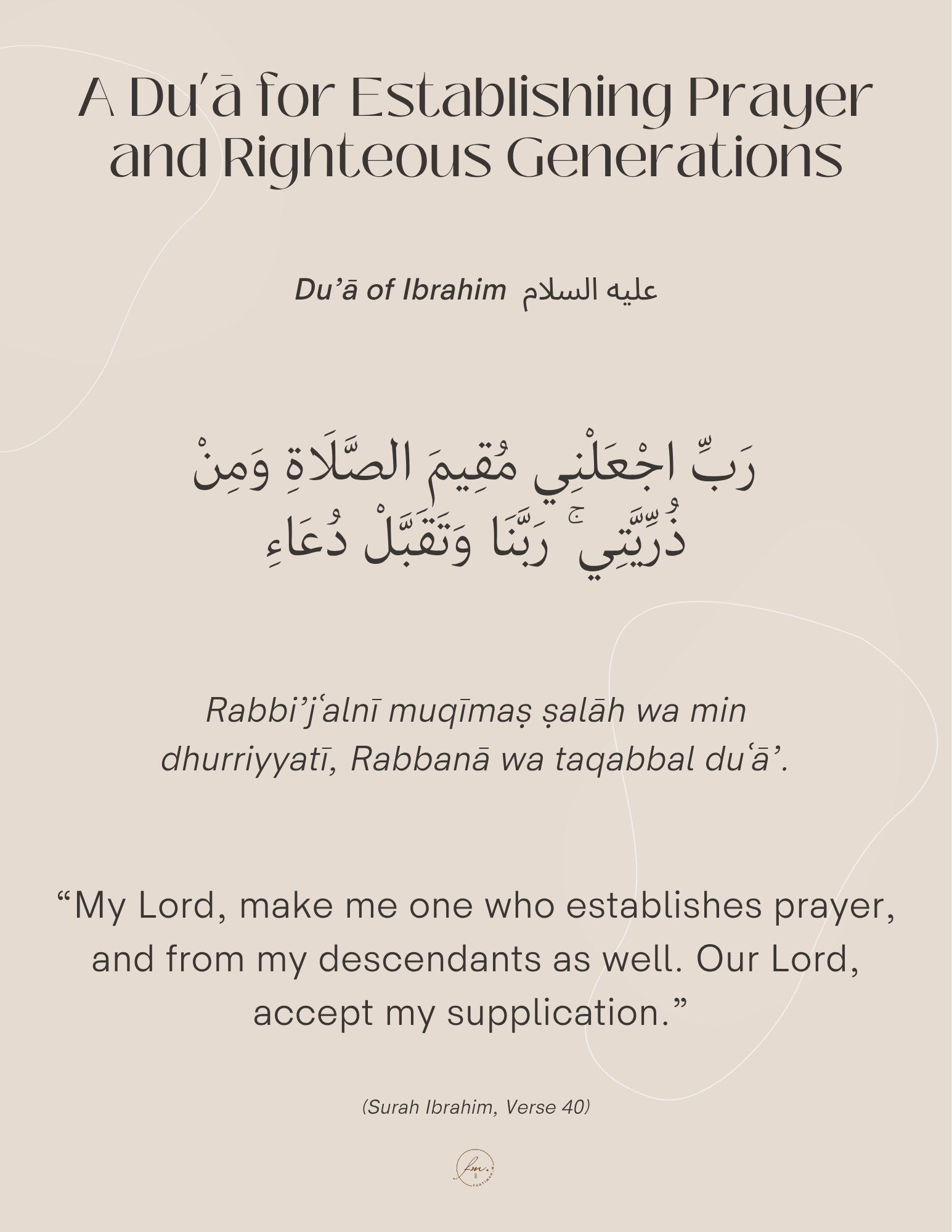
One of the most beautiful du’ās to reflect on during the days of Dhul Hijjah is the du’ā of Prophet Ibrahim:
“My Lord, make me one who establishes prayer, and from my descendants as well. Our Lord, accept my supplication.”
There is something deeply emotional about this du’ā when you reflect on the life of Ibrahim عليه السلام.
Dhul Hijjah carries the legacy of sacrifice, surrender, obedience and trust in Allah. Every part of Hajj reminds us of Ibrahim عليه السلام and his family. A man who was tested repeatedly, yet continued turning back to Allah with sincerity, love and complete trust.
And despite all the immense tests he endured, one of the things he constantly asked Allah for was not dunya status, wealth or ease. He asked Allah to keep him connected to salah.
Because Ibrahim عليه السلام understood something many of us are still learning. When your connection with Allah is strong, you can survive the hardest seasons of life.
So many of us struggle with consistency in Salaah, especially when life becomes overwhelming.
Some sisters are battling emotional exhaustion.
Some are trying to heal from heartbreak and disappointment.
Some are carrying silent anxiety.
Some feel spiritually disconnected and guilty because they have become distant from prayer.
Some pray while their hearts feel numb.
Some want to return to Allah but do not know where to begin.
And this is what makes this du’ā so comforting.
Even a Prophet asked Allah to help him remain steadfast in prayer.
Sometimes we think struggling means we are failing, but this du’ā teaches us that remaining connected to Allah is something we continuously ask Him for. Guidance is a gift. Consistency is a gift. Softness in worship is a gift.
There is also something deeply beautiful about how Ibrahim عليه السلام included his descendants in his du’ā.
“…and from my descendants as well.”
It is such a gentle reminder for us as women.
The du’ās we make today can reach generations after us.
The tears you cry in sujood for your children, future children, family and loved ones are never wasted. Your worship has impact beyond what you can see.
During these blessed days of Dhul Hijjah, perhaps we should ask ourselves:
What is the condition of my connection with Allah?
Not from a place of guilt or shame, but from sincerity.
Because Hajj itself is a journey of returning.
Returning to Allah.
Returning to sincerity.
Returning to humility.
Returning to dependence upon Him.
And maybe this Dhul Hijjah is your opportunity to return too.
Even if your heart feels distant.
Even if your Salaah has not been consistent.
Even if you feel overwhelmed by your past.
Allah does not ask us to return perfect.
He asks us to return sincerely.
May Allah make us women who establish prayer with love and softness.
May He make our homes homes of dhikr and peace.
May He allow our children and future generations to be connected to Him.
And may He accept every whispered du’ā we make during these sacred days of Dhul Hijjah 🤍
The Du’ā of Light & Divine Guidance
There is something deeply powerful about asking Allah for light.
Not just light around us, but light within us.
The Prophet ﷺ would make this du’ā asking Allah to place light in his heart, soul, tongue, eyes, ears, in front of him, behind him, above him and beneath him. He asked Allah to fill every part of him with light.
And perhaps this du’ā resonates so deeply because so many of us know what it feels like to carry heaviness.
Sometimes we are smiling while silently battling overthinking.
Sometimes we are functioning while feeling emotionally exhausted.
Sometimes we look fine outwardly while inwardly feeling confused, disconnected or overwhelmed.
This du’ā reminds us that what we truly need is not perfection. We need light.
Light in the heart when the heart feels burdened.
Light in the mind when thoughts become heavy.
Light on the tongue so our words heal instead of harm.
Light in the eyes so we can see life through the lens of mercy instead of fear.
Light in the ears so we hear truth and not every whisper that tries to make us doubt ourselves.
So many women carry invisible responsibilities.
You are caring for everyone around you while quietly neglecting yourself.
You are trying to stay emotionally strong for your children, your family, your marriage, your friendships.
You are carrying wounds nobody sees.
You are trying to heal while still showing up every day.
And this is why this du’ā is so comforting.
Because it teaches us that Allah cares about every part of us.
Not only our outward actions, but our inner state too.
There are days when a woman may feel spiritually low and struggle to concentrate in Salaah.
Days when anxiety consumes her.
Days when she feels emotionally drained after giving so much of herself to others.
Days when she questions her worth after heartbreak, betrayal or disappointment.
And yet this du’ā gently teaches us to return to Allah and simply ask Him for light.
Because when Allah places light within you, everything begins to change.
You begin seeing your hardships differently.
You begin recognising your value beyond people’s opinions.
You begin noticing blessings you once overlooked.
You begin speaking to yourself with more gentleness.
You begin feeling guided even in uncertainty.
A woman with Allah’s light within her may still face hardship, but she moves through it differently.
There is softness in her heart.
There is calmness in her soul.
There is trust in Allah even when she does not understand what He is doing.
Sometimes the darkness we experience is not always around us.
Sometimes it is internal.
Negative thoughts.
Constant guilt.
Fear of the future.
Pain from the past.
Harshness towards ourselves.
Emotional exhaustion.
Feeling disconnected from Allah because we think we are not good enough.
But Allah never asks us to create our own light.
He asks us to turn to Him for it.
And perhaps one of the most beautiful parts of this du’ā is the ending:
“Give me light, increase me in light, make me light.”
Not just surrounded by light.
Not just searching for light.
But becoming a source of light.
A woman who brings peace into spaces.
A woman whose words comfort others.
A woman who reminds people of Allah through her character.
A woman whose presence feels safe.
A woman who carries softness, sincerity and mercy.
May Allah place light in our hearts when life feels heavy.
Light in our homes.
Light in our healing.
Light in our marriages and relationships.
Light in our motherhood.
Light in our loneliness.
Light in our grief.
Light in our thoughts.
Light in our connection with Him.
And may He make us women who carry His light wherever we go 🤍
A Du‘ā to Heal the Heart and Lighten the Soul
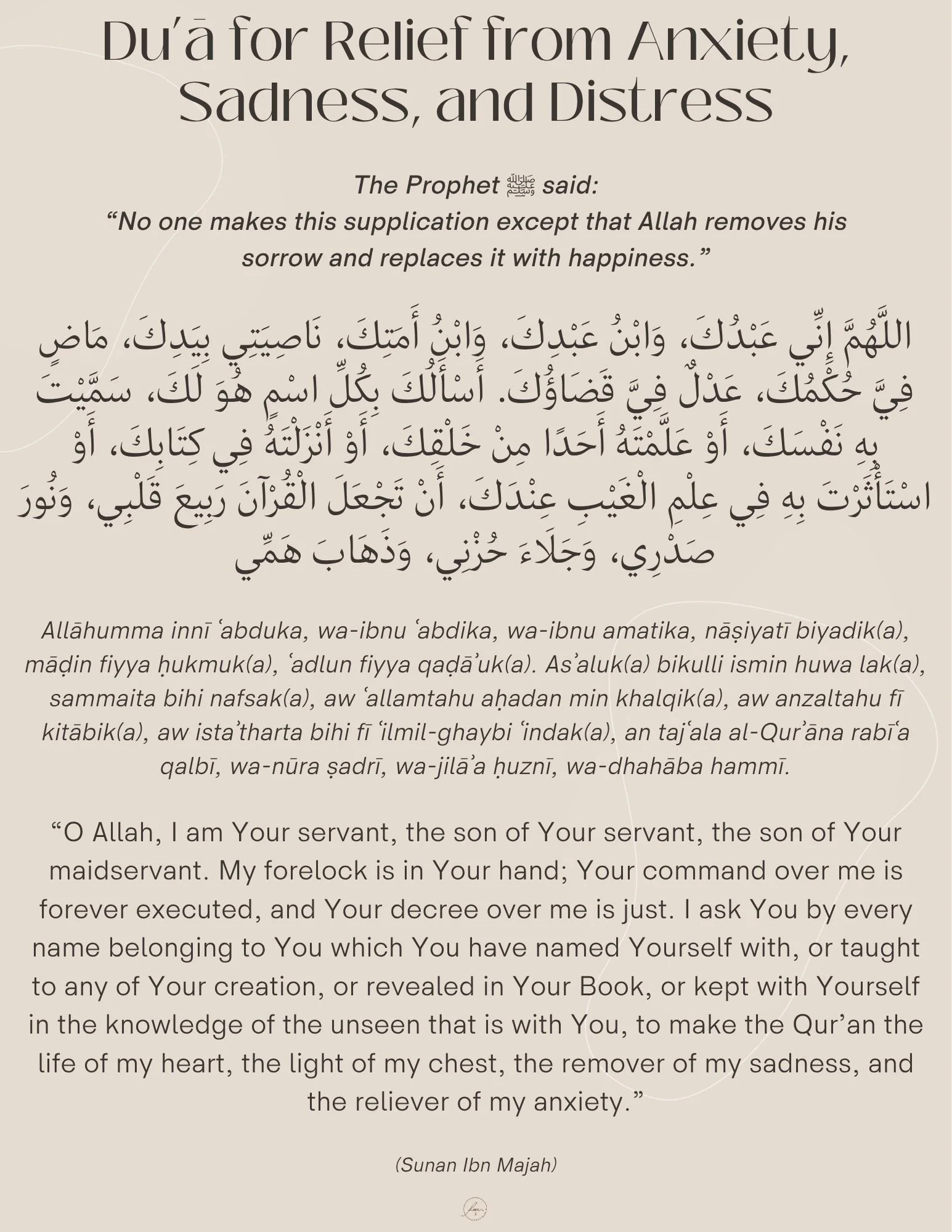
There is a deeply beautiful du‘ā taught to us by our beloved Prophet ﷺ. It is a prayer that holds the power to soothe our hearts, clear our worries, and bring light into our lives, especially in times of sadness, heaviness, and distress.
The Prophet ﷺ used to teach this du‘ā to his companions, encouraging them to hold it close and recite it when life felt too much.
The Prophet ﷺ said: “There is no one who is afflicted by distress and sorrow and says this du‘ā except that Allah will remove his distress and replace it with joy.” The companions asked, “O Messenger of Allah, should we learn these words?” He ﷺ said, “Yes, whoever hears them should learn them.” (Ahmad)
This du‘ā is an honest admission of who we are before our Lord. It begins with humility and surrender. We declare to Allah that we are His servants, completely in His care. It reminds us that our lives, our paths, our destinies are held in His perfect wisdom and justice. No matter what we face, His decree is fair, even if we do not understand it in the moment.
It is an intimate act of placing all our fears, all our confusion, all our worries in His hands. It is saying: Ya Allah, I belong to You. My life is Yours. You know my limits. You see my struggle. You know the burdens I cannot even put into words.
This du‘ā also shows us how to ask Allah by His most beautiful names, even those He has kept hidden in the knowledge of the unseen. It is a way of acknowledging His greatness, His closeness, His infinite wisdom and mercy.
And then comes the most beautiful plea of all, to make the Qur’ān the spring of our hearts. Just as rain brings life to dead land, the Qur’ān has the power to revive hearts that feel dry, weary, or broken. It is the nourishment our souls need. It can bring hope where there was despair, clarity where there was confusion, and light where there was darkness.
We ask Allah to make the Qur’ān the light of our chests. When anxiety, worry, and sadness tighten our hearts, the Qur’ān can fill them with calm, with faith, with trust in Allah’s plan. It can replace the heaviness with ease.
We beg for it to be the remover of our sorrow. How many of us carry grief that no one else sees? Grief over what was lost, over what could have been, over words that hurt us, over dreams that did not come true. The Qur’ān can heal wounds we do not even understand ourselves.
And the reliever of our distress. We all know the feeling of being overwhelmed, burdened, lost. This du‘ā is a lifeline. It is turning to the only One who can truly relieve us, who can take away what weighs on our hearts and minds.
For us as women, this du‘ā is especially precious. We carry so many roles, so many expectations, so many invisible loads. We give so much of ourselves to our families, our communities, and sometimes we forget our own hearts need tending too. We are allowed to admit our weakness. We are allowed to ask for help. This du‘ā is that safe space with Allah, where we can be completely honest about our need and our dependence on Him.
It is a gentle reminder that we do not have to carry everything alone. That we were never meant to. That Allah sees us, knows us better than anyone, and is always there to lift our burdens when we turn to Him with sincerity.
May Allah make the Qur’ān the spring of our hearts, the light of our chests, the remover of our sorrows, and the reliever of our distress. Ameen.