

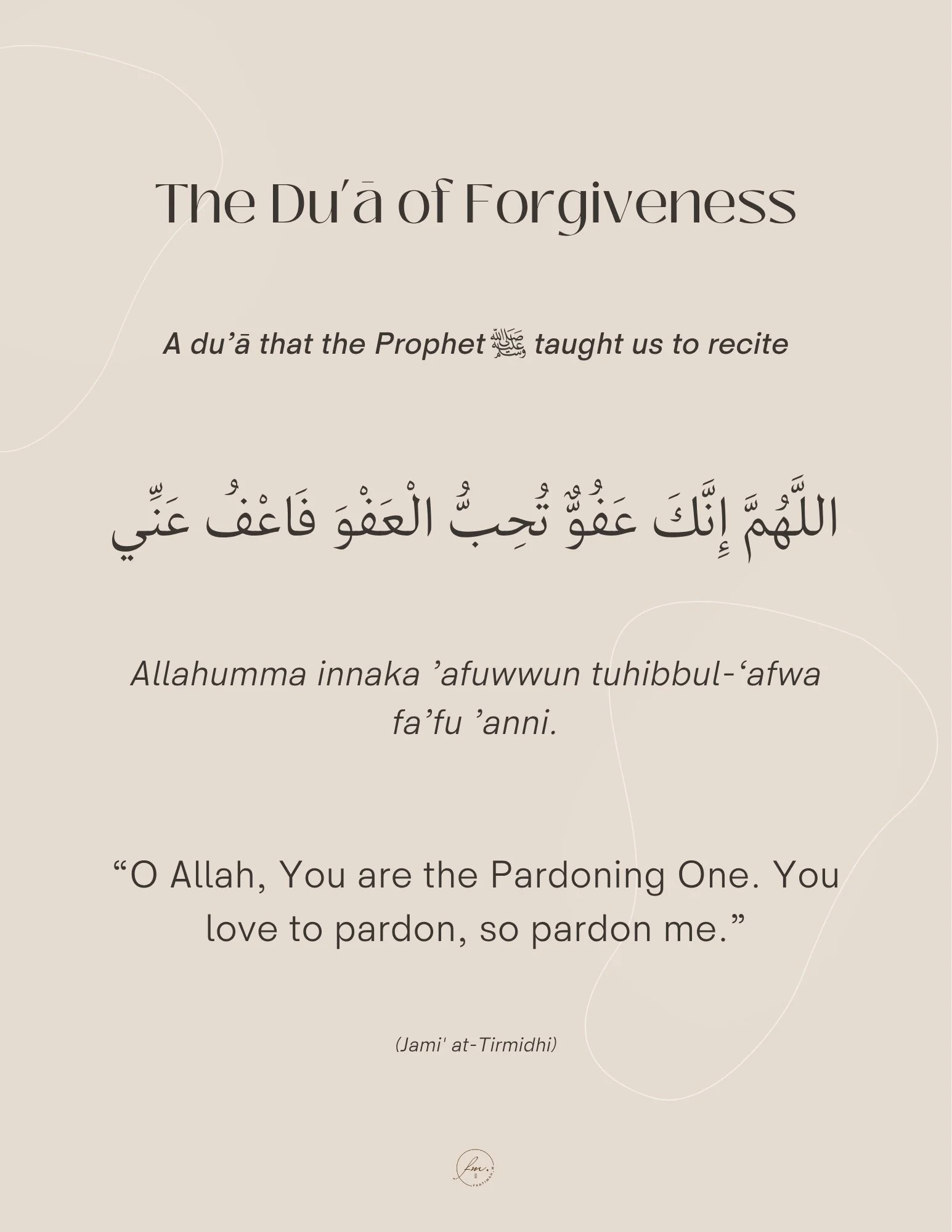
I wanted to share a beautiful du’ā that complements what we are trying to achieve through the Istighfār challenge.
While we will be making Istighfār daily, let us also remember to ask Allah for His complete pardon. There is a beautiful depth to seeking forgiveness, not simply acknowledging our shortcomings, but asking Allah to erase our sins, overlook our faults and pardon us entirely.
This du’ā is a reminder of just how much we need Allah’s mercy and how beautiful it is that we are turning to the One who loves to pardon.
Let us take a closer look at its meaning and reflect on what we are actually asking Allah for.
There are some du’ās that are short in wording but carry an ocean of meaning. This is one of them.
It is a du’ā that the Prophet ﷺ taught us to recite, particularly during Laylatul Qadr, the Night of Decree.
Aishah (RA) once asked the Prophet ﷺ what she should say if she knew which night was Laylatul Qadr. His response was to teach her this beautiful du’ā.
Think about that for a moment.
Out of all the things we could ask Allah for on one of the greatest nights of the year, the Prophet ﷺ directed us towards asking for His forgiveness and pardon.
Not because our other needs are unimportant, but because there is something profoundly valuable about having our sins pardoned by the One who created us.
Let’s take a closer look at this du’ā and the depth of what we are actually asking Allah for.
1. Allahumma innaka ’afuwwun
O Allah, You are the Pardoning One.
We begin by calling upon Allah through one of His beautiful Names, Al-Afuww.
But what does Al-Afuww actually mean?
There is a beautiful distinction between forgiveness and pardon.
When we speak about forgiveness, we often think about being forgiven for something we have done. But the meaning of Al-Afuww carries an even deeper sense. It refers to pardoning, erasing and wiping away.
Imagine writing something on a page and then having it completely erased. The page is no longer carrying what was written on it.
This is the beautiful meaning we are calling upon when we ask Allah through His Name, Al-Afuww.
We are asking the One who has the power to pardon our sins, erase them and not hold them against us.
Think about the sins you remember, the mistakes you regret, the moments you wish you could go back and change.
Think about the things you have done in private that nobody knows about. The times you were ungrateful, the times you fell into sin, the times you allowed your emotions to get the better of you, the times you knew better but still made the wrong choice.
Now think about the fact that Allah is Al-Afuww.
You are not turning to someone who is unaware of your shortcomings. You are turning to the One who knows every detail, even the things you have forgotten, and whose mercy is beyond anything we can comprehend.
You do not have to pretend that you have never made mistakes when you turn to Allah.
You simply have to recognise that you need Him.
2. Tuhibbul-’afwa
You love to pardon.
SubhanAllah. Look at the beauty of these words.
We are not simply asking Allah to pardon us. We are reminding ourselves that He loves to pardon.
How often do we approach Allah feeling as though our mistakes have made us unworthy of asking Him for more?
Perhaps you have repeated the same sin countless times. Perhaps you have struggled with something for years. Perhaps you have made promises to yourself that you would change, only to find yourself falling into the same behaviour again.
And eventually, you begin to feel ashamed to even ask Allah for forgiveness.
But this du’ā reminds us of something important.
Do not allow your guilt to convince you that you should distance yourself from the One whose mercy you need.
Allah loves to pardon.
This does not mean that we should become careless about our sins or take His forgiveness for granted. Rather, it means that we should never allow our shortcomings to make us despair of His mercy.
When you recognise that Allah loves to pardon, you begin to approach Him with hope rather than hopelessness.
You begin to understand that your past does not have to define your relationship with Allah.
You can make mistakes and still return to Him. You can have a difficult past and still build a beautiful future with Him. You can have fallen many times and still keep asking Him to help you rise.
Never underestimate the power of turning to Allah with a sincere heart.
3. Fa’fu ’anni
So pardon me.
Notice how personal this final part of the du’ā is.
We are asking Allah to pardon us.
Not just our major sins, but the small ones too. Not just the mistakes we remember, but the ones we have forgotten. Not just the sins we committed knowingly, but those we fell into through our weaknesses, carelessness and shortcomings.
Think about how much we need this pardon.
We need it for the words we spoke that hurt someone.
We need it for the times we allowed jealousy, anger, pride or resentment to settle in our hearts.
We need it for the moments we neglected our salah, delayed our repentance or allowed the dunya to consume our attention.
We need it for the times we failed to fulfil someone’s rights, the times we were unkind, the times we were ungrateful and the times we did not behave in a manner that reflected the beautiful character Islam teaches us to cultivate.
And perhaps there are things we have done that we have never told another soul.
Allah knows.
We do not have to list every mistake in order to ask Him for pardon. We can simply turn to Him and say:
O Allah, You know what I have done. You know what I regret. You know what I struggle with and what I am trying to overcome. You know the sins I remember and those I have forgotten. I need Your pardon. Please pardon me.
4. Why do we need to make this du’ā so often?
Sometimes we think of forgiveness as something we only need when we have committed a major sin.
But the reality is that we are constantly in need of Allah’s forgiveness.
We are human. We have weaknesses, shortcomings, blind spots and moments when we fall short of what is expected of us.
There are things we do without realising their impact. There are moments when we could have been more patient, more compassionate, more grateful or more mindful of Allah.
And there are sins that we may have become so accustomed to that we no longer recognise how much they affect our hearts.
This is why seeking Allah’s pardon should not be something we reserve for Ramadan, Laylatul Qadr or moments when life becomes difficult.
Make it part of your daily relationship with Allah.
Recite this du’ā in your sujood, after your salah, during your morning and evening adhkār, in the quiet moments before you sleep and whenever you find yourself turning towards Allah.
Do not wait until you feel particularly sinful to ask for forgiveness.
Ask because you are human, and because you will always need your Rabb.
5. Do not let your past keep you from seeking Allah’s pardon.
I think this is something many of us need to reflect on.
Sometimes we carry our mistakes for years.
We remember who we used to be, the choices we made, the things we allowed into our lives and the people we may have hurt. We revisit certain chapters of our lives and wish we could rewrite them.
And while recognising our mistakes can help us grow, constantly punishing ourselves for our past is not the same as sincere repentance.
If you have wronged someone, take responsibility and try to make things right where possible.
If you have fallen into sin, repent and make a sincere effort to change.
If there are habits you are struggling to leave behind, keep working on them and keep asking Allah for help.
But please, do not spend the rest of your life believing that you are permanently defined by the worst things you have done.
Allah’s door of repentance is open.
You are allowed to grow. You are allowed to become a better version of yourself. You are allowed to have a different relationship with Allah from the one you had years ago.
Your past may explain certain things about you, but it does not have to determine who you become.
Keep returning to Allah.
A final reflection
Imagine standing before Allah on the Day of Judgement, knowing that you have made countless mistakes throughout your life.
Imagine how desperately you will need His mercy. How much you will wish that your sins had been forgiven, your shortcomings pardoned and your mistakes erased.
Now think about the fact that you have been given the opportunity to ask for that pardon today.
You do not have to wait until Laylatul Qadr. You do not have to wait until Ramadan. You do not have to wait until you have become a perfect Muslim.
You can begin today.
And perhaps the most beautiful thing about this du’ā is that it teaches us where to turn when we are confronted with our own imperfections.
Not towards despair. Not towards shame that pushes us away from Allah. But towards the One who loves to pardon.
So, dear sister, make this du’ā a regular part of your life.
Say it slowly. Understand what you are asking for. Think about your shortcomings and the immense mercy of the One you are asking.
And never allow the number of your mistakes to make you underestimate the mercy of Allah.
Allahumma innaka ’afuwwun tuhibbul-‘afwa fa’fu ’anni.
O Allah, You are the Pardoning One. You love to pardon, so pardon me.
May Allah, Al-Afuww, pardon our sins, erase our shortcomings, forgive what we remember and what we have forgotten, purify our hearts, accept our repentance and grant us a beautiful ending.
Ameen.