

The Du’ā of Ibrahim عليه السلام for Steadfastness in Salaah
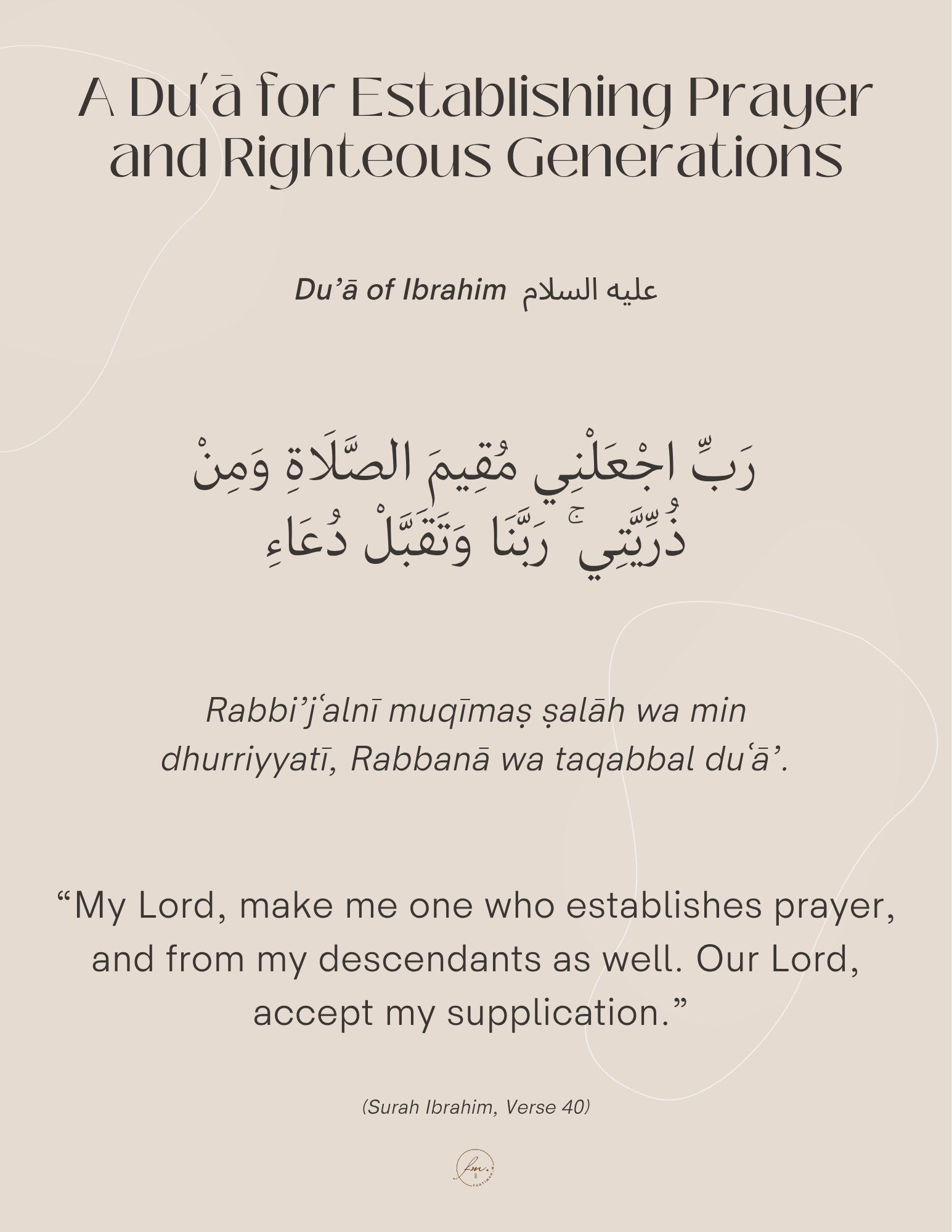
One of the most beautiful du’ās to reflect on during the days of Dhul Hijjah is the du’ā of Prophet Ibrahim:
“My Lord, make me one who establishes prayer, and from my descendants as well. Our Lord, accept my supplication.”
There is something deeply emotional about this du’ā when you reflect on the life of Ibrahim عليه السلام.
Dhul Hijjah carries the legacy of sacrifice, surrender, obedience and trust in Allah. Every part of Hajj reminds us of Ibrahim عليه السلام and his family. A man who was tested repeatedly, yet continued turning back to Allah with sincerity, love and complete trust.
And despite all the immense tests he endured, one of the things he constantly asked Allah for was not dunya status, wealth or ease. He asked Allah to keep him connected to salah.
Because Ibrahim عليه السلام understood something many of us are still learning. When your connection with Allah is strong, you can survive the hardest seasons of life.
So many of us struggle with consistency in Salaah, especially when life becomes overwhelming.
Some sisters are battling emotional exhaustion.
Some are trying to heal from heartbreak and disappointment.
Some are carrying silent anxiety.
Some feel spiritually disconnected and guilty because they have become distant from prayer.
Some pray while their hearts feel numb.
Some want to return to Allah but do not know where to begin.
And this is what makes this du’ā so comforting.
Even a Prophet asked Allah to help him remain steadfast in prayer.
Sometimes we think struggling means we are failing, but this du’ā teaches us that remaining connected to Allah is something we continuously ask Him for. Guidance is a gift. Consistency is a gift. Softness in worship is a gift.
There is also something deeply beautiful about how Ibrahim عليه السلام included his descendants in his du’ā.
“…and from my descendants as well.”
It is such a gentle reminder for us as women.
The du’ās we make today can reach generations after us.
The tears you cry in sujood for your children, future children, family and loved ones are never wasted. Your worship has impact beyond what you can see.
During these blessed days of Dhul Hijjah, perhaps we should ask ourselves:
What is the condition of my connection with Allah?
Not from a place of guilt or shame, but from sincerity.
Because Hajj itself is a journey of returning.
Returning to Allah.
Returning to sincerity.
Returning to humility.
Returning to dependence upon Him.
And maybe this Dhul Hijjah is your opportunity to return too.
Even if your heart feels distant.
Even if your Salaah has not been consistent.
Even if you feel overwhelmed by your past.
Allah does not ask us to return perfect.
He asks us to return sincerely.
May Allah make us women who establish prayer with love and softness.
May He make our homes homes of dhikr and peace.
May He allow our children and future generations to be connected to Him.
And may He accept every whispered du’ā we make during these sacred days of Dhul Hijjah 🤍
The Du’ā of Light & Divine Guidance
There is something deeply powerful about asking Allah for light.
Not just light around us, but light within us.
The Prophet ﷺ would make this du’ā asking Allah to place light in his heart, soul, tongue, eyes, ears, in front of him, behind him, above him and beneath him. He asked Allah to fill every part of him with light.
And perhaps this du’ā resonates so deeply because so many of us know what it feels like to carry heaviness.
Sometimes we are smiling while silently battling overthinking.
Sometimes we are functioning while feeling emotionally exhausted.
Sometimes we look fine outwardly while inwardly feeling confused, disconnected or overwhelmed.
This du’ā reminds us that what we truly need is not perfection. We need light.
Light in the heart when the heart feels burdened.
Light in the mind when thoughts become heavy.
Light on the tongue so our words heal instead of harm.
Light in the eyes so we can see life through the lens of mercy instead of fear.
Light in the ears so we hear truth and not every whisper that tries to make us doubt ourselves.
So many women carry invisible responsibilities.
You are caring for everyone around you while quietly neglecting yourself.
You are trying to stay emotionally strong for your children, your family, your marriage, your friendships.
You are carrying wounds nobody sees.
You are trying to heal while still showing up every day.
And this is why this du’ā is so comforting.
Because it teaches us that Allah cares about every part of us.
Not only our outward actions, but our inner state too.
There are days when a woman may feel spiritually low and struggle to concentrate in Salaah.
Days when anxiety consumes her.
Days when she feels emotionally drained after giving so much of herself to others.
Days when she questions her worth after heartbreak, betrayal or disappointment.
And yet this du’ā gently teaches us to return to Allah and simply ask Him for light.
Because when Allah places light within you, everything begins to change.
You begin seeing your hardships differently.
You begin recognising your value beyond people’s opinions.
You begin noticing blessings you once overlooked.
You begin speaking to yourself with more gentleness.
You begin feeling guided even in uncertainty.
A woman with Allah’s light within her may still face hardship, but she moves through it differently.
There is softness in her heart.
There is calmness in her soul.
There is trust in Allah even when she does not understand what He is doing.
Sometimes the darkness we experience is not always around us.
Sometimes it is internal.
Negative thoughts.
Constant guilt.
Fear of the future.
Pain from the past.
Harshness towards ourselves.
Emotional exhaustion.
Feeling disconnected from Allah because we think we are not good enough.
But Allah never asks us to create our own light.
He asks us to turn to Him for it.
And perhaps one of the most beautiful parts of this du’ā is the ending:
“Give me light, increase me in light, make me light.”
Not just surrounded by light.
Not just searching for light.
But becoming a source of light.
A woman who brings peace into spaces.
A woman whose words comfort others.
A woman who reminds people of Allah through her character.
A woman whose presence feels safe.
A woman who carries softness, sincerity and mercy.
May Allah place light in our hearts when life feels heavy.
Light in our homes.
Light in our healing.
Light in our marriages and relationships.
Light in our motherhood.
Light in our loneliness.
Light in our grief.
Light in our thoughts.
Light in our connection with Him.
And may He make us women who carry His light wherever we go 🤍
A Du‘ā to Heal the Heart and Lighten the Soul
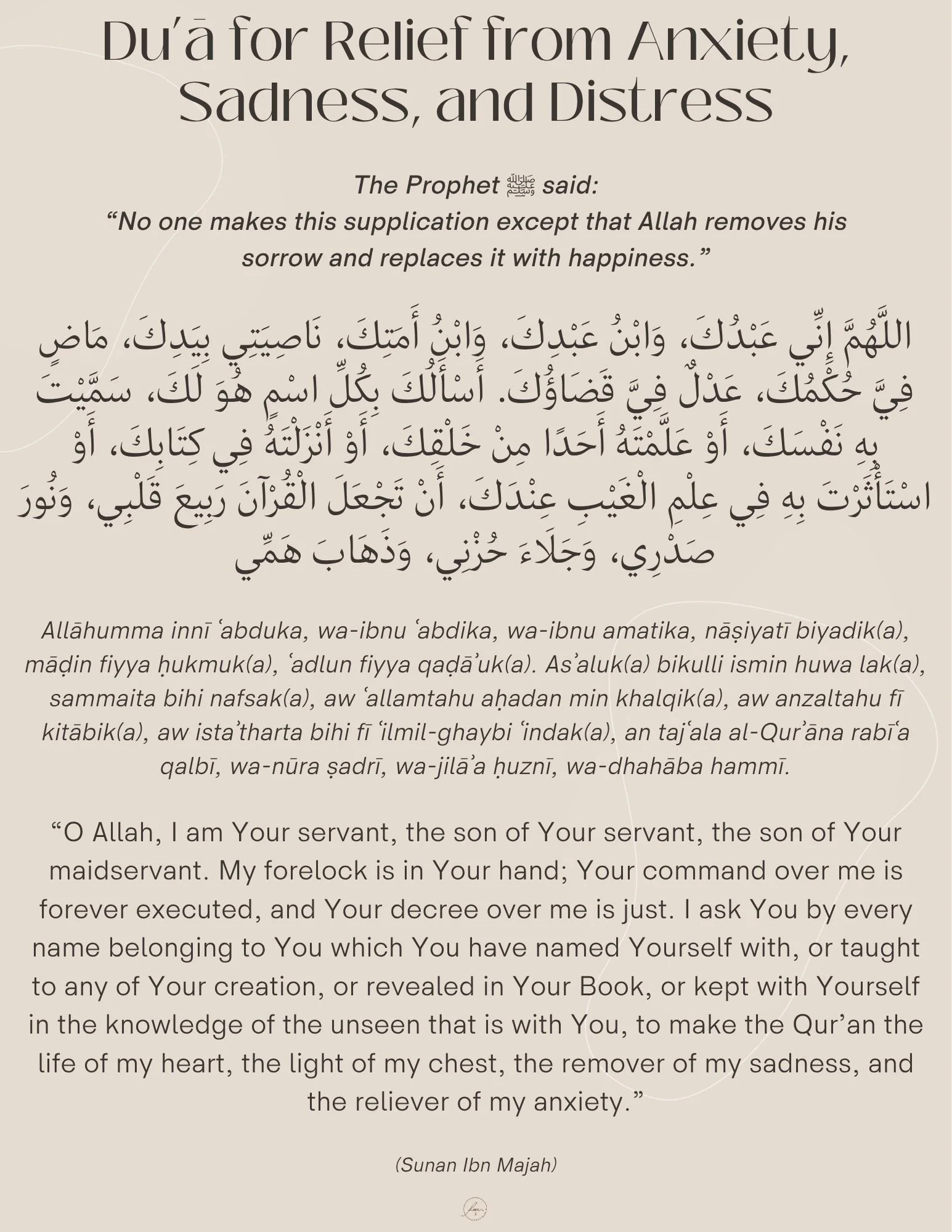
There is a deeply beautiful du‘ā taught to us by our beloved Prophet ﷺ. It is a prayer that holds the power to soothe our hearts, clear our worries, and bring light into our lives, especially in times of sadness, heaviness, and distress.
The Prophet ﷺ used to teach this du‘ā to his companions, encouraging them to hold it close and recite it when life felt too much.
The Prophet ﷺ said: “There is no one who is afflicted by distress and sorrow and says this du‘ā except that Allah will remove his distress and replace it with joy.” The companions asked, “O Messenger of Allah, should we learn these words?” He ﷺ said, “Yes, whoever hears them should learn them.” (Ahmad)
This du‘ā is an honest admission of who we are before our Lord. It begins with humility and surrender. We declare to Allah that we are His servants, completely in His care. It reminds us that our lives, our paths, our destinies are held in His perfect wisdom and justice. No matter what we face, His decree is fair, even if we do not understand it in the moment.
It is an intimate act of placing all our fears, all our confusion, all our worries in His hands. It is saying: Ya Allah, I belong to You. My life is Yours. You know my limits. You see my struggle. You know the burdens I cannot even put into words.
This du‘ā also shows us how to ask Allah by His most beautiful names, even those He has kept hidden in the knowledge of the unseen. It is a way of acknowledging His greatness, His closeness, His infinite wisdom and mercy.
And then comes the most beautiful plea of all, to make the Qur’ān the spring of our hearts. Just as rain brings life to dead land, the Qur’ān has the power to revive hearts that feel dry, weary, or broken. It is the nourishment our souls need. It can bring hope where there was despair, clarity where there was confusion, and light where there was darkness.
We ask Allah to make the Qur’ān the light of our chests. When anxiety, worry, and sadness tighten our hearts, the Qur’ān can fill them with calm, with faith, with trust in Allah’s plan. It can replace the heaviness with ease.
We beg for it to be the remover of our sorrow. How many of us carry grief that no one else sees? Grief over what was lost, over what could have been, over words that hurt us, over dreams that did not come true. The Qur’ān can heal wounds we do not even understand ourselves.
And the reliever of our distress. We all know the feeling of being overwhelmed, burdened, lost. This du‘ā is a lifeline. It is turning to the only One who can truly relieve us, who can take away what weighs on our hearts and minds.
For us as women, this du‘ā is especially precious. We carry so many roles, so many expectations, so many invisible loads. We give so much of ourselves to our families, our communities, and sometimes we forget our own hearts need tending too. We are allowed to admit our weakness. We are allowed to ask for help. This du‘ā is that safe space with Allah, where we can be completely honest about our need and our dependence on Him.
It is a gentle reminder that we do not have to carry everything alone. That we were never meant to. That Allah sees us, knows us better than anyone, and is always there to lift our burdens when we turn to Him with sincerity.
May Allah make the Qur’ān the spring of our hearts, the light of our chests, the remover of our sorrows, and the reliever of our distress. Ameen.